Sunday, December 4, 2022

A Ten Best Films List


The recent re-occurrence of the decennial Sight & Sound poll has inspired an outpouring of lists, thoughts about lists, complaints about lists, etc. My own opinion about it all is that—you know what, I’m actually going to refrain from voicing any opinions about it at all. But it makes one think about what one would put on one’s own list of the “ten greatest films of all time” and, well, here we are. I’ve always preferred lists that come with commentary so that the titles of the films don’t just stand there naked, somewhat impotent, easy for eyes to glaze over when reading. So I’ve made my own list with commentary on each entry. It’s presented in alphabetical order, and with the personal rule for the sake of variety to include only one film per director. Apologies to many films and directors for their stinging absence—most especially Chaplin, Bresson, Godard, Visconti, and Nick Ray—but here’s what I chose. (A more expansive and ranked list of my personal 100 favorite films can be found here.)


The 15:17 to Paris (Clint Eastwood, 2018) 


Clint Eastwood was already a first ballot pantheon filmmaker before he ever entered his twilight years—which arguably began a quarter century ago already. Multiple late periods later (1997-2009, 2010-2019, 2021-??) he’s reached a sui generis place in the contemporary cinema landscape that one might turn to jokes to describe but is in fact too moving for me to truly articulate. At 87 years young he made this, an alien object that is perhaps more human than any other film released up to that point. Just normal people—so normal it is the actual people—thrust into a moment beyond time. The greatest film about divine providence. More experimental than most “experimental” films. Aggressively phenomenological and philosophical. I was caught off guard by how moved I was by it in my first encounter early in 2018, but revisiting it (and revisiting it and revisiting it and...) I literally cannot refrain from balling my eyes out during the climactic moments of this film. Words cannot suffice (even though I once tried); a movie where everything fades away and there’s just the people, their faces, and a prayer....

“I don’t know, man, d’you ever just feel like life is just catapulting you towards something, some greater purpose?”


The Godfather: Part III (Francis Ford Coppola, 1990)


The Godfather: Part III was a mercenary work. The Godfather: Part III was an unnecessary work. The Godfather: Part III is also the highest Gesamtkunstwerk in the history of American cinema. By film historical happenstance (& blindness) it is little more than a footnote in the public consciousness to the first two Godfather films Coppola made in the 1970s, but is in fact as great and greater than those previous masterpieces. By being made 15 years after the fact, Coppola’s career-long central theme of time is stamped on its very existence, on the faces of Al Pacino, Diane Keaton, Talia Shire, and in the presence of 19-year-old Sofia Coppola (after appearing as a newborn infant in the trilogy’s first film) in what is one of the greatest performances (amateur or professional) in the history of cinema. I’m getting stuck in superlatives: this film is a magnificent opera, a two-and-a-half-hour novel, a series of religious paintings, a ballet of bodies and words and whispers and glances. Michael’s silent scream is the single most piercing moment in all of cinema, and a moment I will never recover from. 


The Green Ray (Éric Rohmer, 1986)


The greatest film about the philosophy of living. Rohmer flips through the summer calendar and gives us some shots and cuts, exceedingly normal and exceedingly beautiful. But we all know what we’re here for: the titular green ray, the appearance of which constitutes cinema’s greatest miracle. No other symbol of pure, unadulterated hope even comes close to the power of this little sliver of green squeezed between water and sky. And oh how earned it is—the little cuts and bruises of life, and also the big lonelinesses and longings of it, are so simply and realistically represented prior to this moment that the green ray feels like no less than God himself entering the movie to comfort me with a cosmic sign of infinite reach. Like Marie Rivière in the reverse shot, all one can do is laugh and cry at the absurd beauty of it all.


Heaven’s Gate (Michael Cimino, 1980)


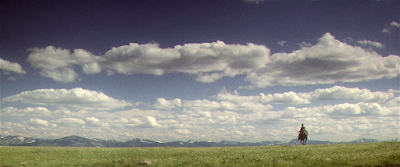
The most titanic and monumental motion picture ever made. A near four-hour post-Western slab of American melancholy that—thanks to Cimino’s stubborn commitment to translating the impossibly grand artistic vision in his head into actual reality and then onto actual film—you breathe in, wade through, and die along with rather than just watch. This is the movie they should send to the aliens in order to explain America. Visconti in the wild west. Its huge-ness is counterbalanced by its infinite termiticism, every blade of grass and every cloud in the sky counting for as much as its sweet romanticism and operatic tragedy. The coda with made-up-old Kris Kristofferson on the verge of tears is the most succinct and moving gesture ever recorded about America’s proclivity for snuffing out youthful idealism. And American cinema’s snuffing out of Cimino for making this is almost too much to bear.


A Hidden Life (Terrence Malick, 2019)


It’s hidden in the middle of this list of ten, but this is the greatest film of all time. There’s no recency bias here—I’m sorry that the greatest filmmaker of all time happens to still be alive and happens to make his best film every time he decides to make another one. But it almost feels wrong to have this film on this list in a way that it wouldn’t feel wrong to have any of his other 21st century pictures on it, because this film is post-cinema: yes, the shots and cuts are beautiful beyond words, and nobody can retain an emotional throughline within a fractured decoupage like Malick, but after an experimental modern-day trilogy our greatest film poet sat down and made a film about what really matters. This film is explicitly and specifically and quintessentially theological in the most profound way it is possible for a film to be, and which I dare say no other is. A hint at why: love, real love, real Christian love. This is all that matters. To quote the end of Song to Song: “This. Only This.”


I’d Climb the Highest Mountain (Henry King, 1951)


Humble Fox studio craftsman (read: artist) Henry King gave us this humble masterpiece in a humble genre that he humbly excelled at: the pastoral. It’s a somewhat rare genre that I’d suggest is made out of a combination of the western and the melodrama—classic Hollywood’s two greatest staple genres. So to say that I’d Climb the Highest Mountain is the best Hollywood pastoral is to already say that it is one of the greatest films of all time. Only the essentials here: love, family, religion, community, death, etc. Nothing about it on the surface of things would alert you to the power it contains; its reputation (if it even has one) as a more or less forgotten studio film is demonstrated by the fact that no one has cared to restore it. But it is arguably the most utopian film in the annals of Hollywood, and profoundly so because it doesn’t paper over the sad realities of the world to be that. There’s nothing else like it.


My Darling Clementine (John Ford, 1946)


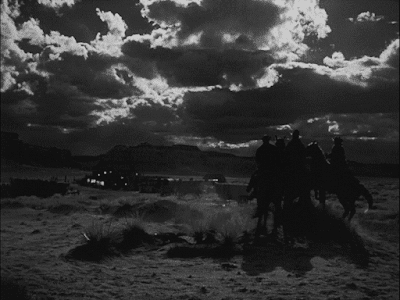
Two words: those clouds. The most elegant and beautiful and absolutely head-to-toe perfect film classic Hollywood ever produced. John “I make westerns” Ford was a poet and a genius and had more intuitive artistic sense for where to place the camera and when to cut than 99% of the European arthouse masters, and this film proves it. Every frame of My Darling Clementine is a sight to behold, every movement of the camera is as natural as breathing, every actorly gesture contains infinite unspoken meaning. All this for a simple little western story that we’ve heard a dozen times before, of Wyatt Earp and Doc Holliday and the shootout at the O.K. Corral, but this is a film seemingly touched by God and therefore full of grace to the point of splendor. Ford made countless other masterpieces but none were so casual in their pure brilliance as this; none so beautiful in the fullest moral and aesthetic sense.


The Souvenir: Part II (Joanna Hogg, 2021)


Greatness is greatness is greatness is greatness, so to leave off a film just because it premiered last year is to lie to yourself and others. Like many of the greatest sequels this film sort of cheats by harnessing the power of not just one film but two: Joanna Hogg doubles down on the autobiographical drama of the first Souvenir film and then goes on to transcend it by the single most remarkable meta gesture in the history of cinema. Intellect and emotion, rigor and tenderness, Part II is intimate intimate intimate while also touching on the world-historical; it mines the auto-personal to reach a profundity that is vast—and impossibly moving. But all this happens on a small little level, the level of the cut, the level of the sound design, the level of a filmmaking intelligence tuned into every aspect small and large of what makes a movie a work of art. And of course this is all in service of something so simple yet so foundational: how to think, how to live.... 


Vertigo (Alfred Hitchcock, 1958)


I had planned to give this slot to Torn Curtain (1966), my second favorite Hitchcock, to give that film a boost and to avoid giving a space to a film that no longer really needs to be discovered—but then I realized that this would be dishonest. There’s a reason Vertigo has been a mainstay on such lists; there’s a reason it has a claim on being, objectively, the greatest film of all time: because it’s the greatest film about subjectivity. About subjective desires and the objective reality preventing them. And it’s about this in a way that is both uncomfortable and moving; the film latches on to the viewer’s heart like a leech, hypnotic, un-look-away-able, sucking you in and indicting you—and it’s enjoyable, in some twisted way. This is easily the darkest film on this list, a horror film in the guise of a melodrama, a violent movie, an awful movie, a scarred and scarring movie, and ground zero for what cinema is, ontologically, all about. This film will be at the heart of cinema and cinephilia for as long as humans exist, and this is both scary and beautiful.


The Yards (James Gray, 2000)


Bone-deep sadness and melancholia drip off this film like molasses. It looks like a religious painting from the 17th century and moves like a turn of the century Italian opera. It has the novelistic depth of a 19th century Russian tome and the incisive social commentary of a 20th century French philosophical text. I’ve already spent 12,000 words trying and failing to articulate the epochal greatness of this film elsewhere, but that’s apt: this is the art of the moving image we’re talking about here, which at it’s most essential is inherently impossible to translate into words. So all we have are emotions, feelings—and I don’t know how to share those with you wordlessly. Perhaps by telling you (in words, alas) of how I encountered this film at 18 and, for the very first time in my life, was moved to tears by a movie—to ugly, torrential tears. This film will be with me forever.

Saturday, November 5, 2022

Jordan Mintzer: Reportage from the Set of Armageddon Time


The following is an article written by Jordan Mintzer, originally published in the French Magazine So Film (#91, May-June 2022); as far as is known he was the only journalist allowed behind the scenes of the Armageddon Time set, and this piece comes from that experience. (It was written before the film’s Cannes premiere, so he hadn’t seen it yet.) I struck up an email conversation with Jordan after sharing my book on James Gray with him, and he was kind enough to not only share this article with me (the original, “longer and better” English version he wrote) but also to give me permission to publish it here on my blog, as it has never been published online or in English yet. The reason I reached out to Jordan in the first place is that he is my progenitor in the field of James Gray scholarship, having published the first and to date only book of interviews with Gray and his collaborators, Conversations with James Gray (2012). He is also the author of Conversations with Darius Khondji (2018) and the newly released Conversations with Dean Tavoularis (2022), which is available from Synecdoche here. (The photo above comes courtesy of Jordan, and the rest come from those that accompanied the French publication of the article.)


The King of Queens

By Jordan Mintzer


True story: When I was a teenager, I worked after school and on the weekends at a bakery in the Queens neighborhood of Forest Hills, where I grew up. It was located nearby the Kew-Forest School, an elite private institution founded in 1918 that, having been a public school student myself, I only knew because of its stately red Neoclassical facade, which stood out amid all the surrounding middle-class apartment houses.

The year was 1992 and I was already a major film buff back then, chatting about this or that new movie with customers in the bakery as they bought coffee and bagels. One afternoon, a kid a few years older than me walked in and, when he heard I was into film, asked me if I knew James Gray. “No,” I said. “Who’s that?” “He went to Kew-Forest,” the kid said, “and he knows more about movies than anyone. He knows every Coppola and Friedkin film by heart!” The kid bought some bagels and left, but not before he told me: “James is out in L.A. now and he’s going to direct his first feature...” It would take Gray two more years to make Little Odessa, which came out in 1994, but he was already something of a local legend. Suffice to say that I never forgot his name.

Fast forward to thirty years later. James Gray has since directed seven movies, ranging from a trio of New York crime dramas (Little Odessa, The Yards, We Own the Night) to a pair of intimate melodramas (Two Lovers, The Immigrant) to an epic adventure drama (The Lost City of Z) to a $90 million sci-fi drama starring Brad Pitt (Ad Astra). He’s premiered four of his films in competition in Cannes, won a Silver Lion in Venice when he was only twenty-five, and is part of a generation of American auteurs, including David Fincher, Quentin Tarantino, Wes Anderson and Paul Thomas Anderson, who came up in the 1990s and are now some of Hollywood’s most lauded and iconoclastic filmmakers.

For his eighth feature, Armageddon Time—the title comes from a 1979 song by The Clash that was released as a B-side on the “London Calling” single—Gray has decided to return to Queens to direct his most personal movie yet. The film is something like The 400 Blows meets Amarcord, with the action set in 1980, the year of Ronald Reagan’s election. Parts of the story take place at the very Kew-Forest School where the director first became known, at least to a few kids around the neighborhood.

But here’s the twist: The Kew-Forest School not only includes James Gray as an alumnus, but another infamous Queens native by the name of… Donald Trump. The billionaire mogul/reality TV star and 45th President of the United States was born two decades before Gray and is not directly the subject of his movie, although the Trump family and its legacy loom over events in the film the same way Reagan does. (Another true story: Donald Trump was kicked out of Kew-Forest when he was thirteen years old for punching a music teacher in the face. Afterwards his father sent him to the New York Military Academy, where one the other students was… Francis Ford Coppola.)
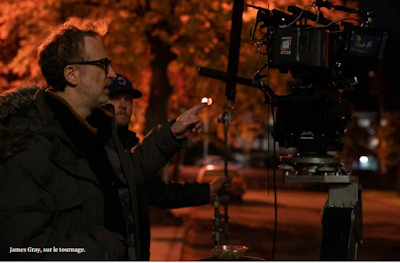


The subject of Armageddon Time is something deeper and more intimate for Gray, whose eleven-year-old surrogate in the film, Paul Graff, is played by newcomer and fellow redhead Michael Banks Repeta. It’s a coming-of-age story as only he could make it, one with moments of boisterous Jewish family humor—a first for the director, who in person can be much funnier than his movies—but also a heartbreaking look at what it’s like to grow up and experience loss for the first time. The loss of friends, loved ones and, most of all, one’s own innocence at a moment when America made its turbo-charged shift to neoliberalism as Reagan took power in 1981, opening a social and economic divide that would widen, and eventually explode, with the election of Trump in 2016.

“The movie’s called Armageddon Time, not Everybody’s Going to Be Happy Time,” Gray told me on Zoom one morning from Los Angeles, where he has lived ever since attending USC film school there in the late-1980s. “The world was a pretty dark place back then, and it reflects on us now, because class matters big time—as does race.”

Indeed, and without giving too much of the plot away before the movie makes its world premiere in Cannes, the story revolves around young Paul and his friendship with a black student, Johnny Davis (Jaylin Webb), and what happens when they both get kicked out of their public school for smoking a joint in the bathroom.

For Paul, whose bickering if supportive parents, played by Jeremy Strong and Anne Hathaway, and mensch of a grandfather, played by Anthony Hopkins, are looking out for his best, the answer is the Kew-Forest School, where he enters a world of WASPs that’s ruled by Donald Trump’s father Fred, who presides over the school’s board of directors. For Johnny, who lives alone with his grandmother, it’s another story.

The events in the film are inspired by Gray’s own experiences, and after using a range of genres to explore themes that are dear to him, especially class issues and the strained, often destructive relations between fathers and sons, in his other movies, this is the first time he’s decided to turn the camera directly on himself. “Quite simply, my views have changed a little bit over the years,” he explained. “I’ve become so uninterested, I mean unbelievably uninterested, in genre. It doesn’t mean that I don’t love genre movies, but as a means of expression—and others were able to do it brilliantly—I think I’m less able to get directly at my feelings through genre than I would have hoped.”

Armageddon Time is also the first time Gray has cast children in the lead roles—Edward Furlong was already fifteen and a major movie star, following the release of Terminator 2: Judgment Day, when he made Little Odessa—and he found the experience to be different from what he was used to. “You have to kind of forget the playbook,” Gray said. “When you work with seasoned actors, they can give you something different each time. I found that with kids you have to give them more line readings and tell them how you want them to say something. You have to try to reach them in a way so that you get exactly what you want, which may not always be more than what you want.”


When I spent a few days shadowing the director on set in October of last year, I saw evidence of this as he talked Repeta and Webb through a dialogue scene that he was trying to get in one long, lateral tracking shot. The sequence was shot in front of P.S. 173Q out in in Flushing, Queens—the actual public school Gray attended, and was kicked out of, as a kid. As the setting was 1980, and not 2021, the student body, which is now predominantly Asian, was replaced by dozens of white and Black extras, all of them decked out in period attire and hair styles (bellbottoms, afros, lots of suede and denim) as they ran through the scene with Gray’s assistant director and co-producer, Doug Torres.

An hour or so earlier, the camera department had laid out thirty-five meters of track on the sidewalk, and the real students of P.S. 173Q, along with a bunch of gawking neighbors, began to gather across the street to watch what was happening. One young girl, accompanied by her mom, pointed to Gray as he stepped onto set to begin rehearsals with the cast. “The guy with the hat is the director!” she yelled out, excited that a film was being shot at her school, even if she had no idea who Gray really was.

Moviemaking, though, whether it’s on a Queens street or a soundstage at Paramount—where most of Gray’s last opus, Ad Astra, was shot—can be tedious, repetitive and, if you have no real reason for being there, frankly a bore to witness. Once the director walked Repeta and Webb through the shot, he realized they did not have the latest pages of the script, which he had rewritten a few weeks earlier. The kids now had to memorize several dozen new lines, which Gray went over with them, until they were able to do the scene in an uninterrupted two-and-half-minute shot. All of this went on as airplanes began to land every other minute at nearby LaGuardia airport, causing a roar that ruined several takes. Soon enough, the crowd across the street began to thin out to only a few stragglers, while Gray kept working through the scene until he got it right.

“We did twenty-seven takes,” he reminded me afterwards from L.A. “There was the issue with the dialogue, and the planes overhead. Every single take was botched except for the last one, so I got one good take. Which, by the way, is all you need.”

The controlled chaos of shooting out in Queens was on fine display a day earlier when the crew, consisting of roughly a hundred people, rolled up in Flushing Meadows Park nearby the ruins of the 1964 New York World’s Fair. It was a windy and overcast day, winter already encroaching on fall, and I decided to walk to the set from the apartment where I grew up, and where my mom still lives, located only a few kilometers away.

Before getting anywhere near the camera, which has been set up across from the ghostly towers of the Fair’s original New York State pavilion, I had to submit to a Covid test at a temporary facility in the production’s base camp. This was actually the third test I had taken after going to a testing center out in Brooklyn to be pre-tested several days beforehand, then waiting a few more days to be cleared. There was an entire team on Armageddon Time dedicated to enforcing the U.S. film industry’s pandemic safety protocols, resulting in a shoot that remained Covid-free but also saw its budget—estimated at $16 million—hit by hundreds of thousands of dollars in additional costs. 

While getting my nose swabbed, I recognized the cinematographer Darius Khondji sitting nearby, getting swabbed as well. Once the tests were done, the two of us walked to set together. Khondji, who was shooting his third James Gray film after The Immigrant and The Lost City of Z, filled me in on their latest collaboration, including the fact that this would be the first movie the two shot together digitally, on the Alexa 65.

Gray, an adamant film enthusiast who originally wanted to shoot Armageddon Time on 16mm, had vowed in the past to never go digital, but a few factors changed his mind this time around. One were the tests that Khondji ran during pre-production, revealing how well the Alexa 65 could mimic the look of celluloid. Even more decisive were the possibilities the digital camera and its sizeable chip allowed for creating new shots in post-production, such as close-ups of the actors, which could save everyone time on set. With only thirty-two days allotted for shooting—a limited schedule for a 130-page script that would ultimately result in a two-hour-long feature—switching to digital was a way to get it all in the can, or into the hard drive, without exceeding an already tight budget.


Another decisive factor was the working method that Khondji had developed on the feature he had shot just beforehand using the Alexa 65, Alejandro Iñarritu’s upcoming Mexican film, Bardo. For that movie, the cinematographer had brought along a New York-based DIT (Digital Imaging Technician) named Gabe Kolodny, who built a “portable lab on set,” as Khondji described it, where the digital footage could be graded and manipulated in real time. Instead of waiting for the end of the edit to color correct the feature, which is how things are traditionally done, the movie could be pre-graded as it was being shot, allowing Khondji and Gray to tweak the images while they made them.

I spent lots of time on set inside the darkened DIT tent, which was decked out with so many monitors, keyboards, dials and controls that it looked like some sort of remote CIA operations center. On a piece of paper glued below one of the monitors, Kolodny had scribbled down a few key words from Gray that would serve as guidelines for the film’s imagery: “Visual distance, but no emotional distance; Time that is gone; A ghost; Unreachable; A relic.” When scenes were shot, Khondji would join us inside the tent and radio back instructions to his camera operator, Julian Delacruz, and first assistant camera, Eric Swanek, who would then make adjustments on set, adding filters or perfecting movement.

Like many crew members, Swanek has been a loyal part of Gray’s team since We Own the Night back in 2007, and each time the director shoots in New York it’s somewhat of a family reunion. And yet the local film industry has experienced a seismic shift over the past two decades, with television production now far surpassing that of movies. Many technicians on the crew were working on Armageddon Time in between jobs on two of the biggest shows now made in New York, Showtime’s Billions and HBO’s Succession. The budget of the last season of the latter was said to reach up to $100 million, making Gray’s movie a small art-house affair, and more like a labor of love, for many involved.

The day in Flushing Meadows started off calmly enough, with Gray rehearsing a long dialogue scene between Repeta and Anthony Hopkins, who everyone called “Tony” on set. There was hardly anyone in the park except for a few joggers or cyclists, and Gray talked Repeta through his lines as the 83-year-old Hopkins benevolently looked on, cracking jokes to the makeup team in his familiar Welsh accent. (Gray was able to work the accent into Hopkins’ character, a Russian-Jewish immigrant, by explaining how, like the director’s own grandfather, he had lived in England prior to arriving at Ellis Island.)


By the time they were ready for the first take, something strange began to happen. As I stood nearby Gray, who had headphones on and was glued to his monitor, I noticed several men darting in and out from behind the trees in the background, just out of the camera’s range. At first I thought they were passersby curious about a movie shoot. But then I noticed they all had cameras with extra-long zoom lenses. In fact, some of them had two or three such cameras strapped around their necks.

It’s unclear how the paparazzi managed to find us all the way out in Queens, a good hour’s drive from Manhattan. (A crew member told me they may have a source in the Mayor’s Office of Media and Entertainment who tips them off.) Now there were at least a half-dozen of them snapping hundreds of photos of Hopkins, and they all seemed to follow the lead of one man: New York paparazzo Steve Sands, who’s so legendary in his field, and so hated by celebrities and film crews, that the main character in Tom Dicillo’s 2006 comedy Delirious, played by Steve Buscemi, was apparently based on him.

If you look Sands up online, which I did while on set, you will see lots of pictures of him being manhandled or beaten up by either cops or security guards, his body hitting the pavement at odd angles. The photographer is decidedly familiar with his free speech rights under the First Amendment, which grant Constitutional protection for photos taken in a public place, and he is known to file lawsuits against anyone who dares lay a hand on him. Because Gray and his crew were shooting that day in a public park, all they could do was tolerate Sands and the rest of the paparazzi’s constant, infuriating presence.

At first the photographers kept their distance, but as the day went on they got closer and closer, eventually going right up to Hopkins after Gray yelled “cut” so they could snap close-ups from a few feet away. When Anne Hathaway arrived on set later in the afternoon for her scene, all hell started to break lose. The star’s bodyguard and a few production assistants did their best to keep the paparazzi back, but they broke free, swerving in between cast and crew to get shots of the Oscar-winning actress. People started shouting and the photographers got more frantic, threatening crew members and sometimes each other. The competition for exclusive on-set photos, which would be sold that night to The New York Post or The Daily Mail, was brutal and unforgiving.

Gray, well familiar with this ordeal from his many New York productions, looked on with a mix of detachment and disgust. At some point Sands was yelling “First Amendment!” at one of the PAs, and Gray to me turned and said: “I’d love to see someone kick the shit out of him, I really would.” He added: “You can quote me on that.”

The director was getting a little nervous because they were beginning to lose daylight and still hadn’t shot Hathaway’s sequence, where she would roll into the park with Repeta in a vintage Plymouth Belvedere—the same car Gray’s parents drove when he was a child. The picture vehicle was finally wheeled in with a camera installed in the back, and there was only time for a few technical rehearsals before Khondji pushed everyone to get moving before the sun went down and the day was officially over.

Film shoots are odd beasts: crew members can sit around for hours with nothing to do—although phones have probably made the whole thing less monotonous—and then suddenly there’s a flurry of activity and you only have minutes to pop off a major shot. That’s why the level of technical expertise needs to be so high, and that’s why movie productions are sometimes compared to wars, as Coppola famously said about Apocalypse Now and Vietnam. You need to be ready to move into battle, and move fast.

In this case, everything came together at the last second for a shot—“one of the most beautiful in the film,” per Khondji—of Hathaway seen through the windshield of the Plymouth. The paparazzi were finally pushed back and the crew quieted down as they got ready to roll. But just before Gray called “action,” Hathaway signaled something was wrong, and the assistant director went rushing over to her. They talked for a few seconds and then the assistant turned and came over… to me. I was standing by a tree facing the scene from about twenty meters away, and Hathaway told him I was directly in her eye-line, ruining her concentration. So they got rid of me as well, and got what they needed.

When I reminded Gray about that day a few months later, after the production had wrapped, he waived away my idea that Armageddon Time had been a particularly chaotic shoot. “I don’t want you to pull from that experience the entire narrative that it was always chaos, because it’s not true. That was the case for that day, or day-and-a-half, but it was not typical. Typically we were in a house in New Jersey for two-and-a-half weeks, and I could hunker down with the actors and really get what I wanted.”


Although Gray’s eight feature will be his quintessential Queens movie, the majority of it, beyond the days that I was on set, plus a couple more, was actually shot in New Jersey both for budget reasons and for the locations it offered—including a school that could stand in for Kew-Forest, which refused to be involved in the production.

When Gray originally went back to scout his old neighborhood of Flushing, he realized the place had changed far too much to turn back the clock to 1980. The racial demographic had not only shifted, from Jewish, Irish, Italian and Black to Asian and Orthodox Jewish, but many of the original homes had been knocked down and replaced by new structures, including a slew of dacha-style McMansions covered in marble. The director found a substitute for his neighborhood in the middle-class New Jersey town of Bayonne—“the land that time forgot,” as he put it—and shot most of his film there.

Switching states, switching to digital, shooting a period piece in only 32 days—or 35 days if you add two reduced-unit days and one day at the Guggenheim Museum… It seemed like a lot of concessions for a filmmaker to make, especially one whose previous movie was a sci-fi blockbuster released by Disney that had cost five times as much. I was reminded of what the director said during a location scout that took place in the morning of one of the shooting days, when he and key crew members walked around a Jewish cemetery in Queens, searching for the right spot to stage a pivotal funeral sequence.

As Gray wandered amid the tombstones accompanied by Khondji, who used a special app on his iPhone as a viewfinder, the rest of the crew—producers, production designer, visual effects supervisor, location manager—as well as the manager of the cemetery, weighed in on what could and couldn’t be done. One angle looked perfect to Gray, but you could see the Manhattan skyline in the distance and it would cost too much to transform it back to 1980 using CGI. Another angle, with a graffiti-filled wall in the background, looked great as well, but under copyright laws they would need to get clearances from the original graffiti artists, which was virtually impossible.

“At a certain point, I guess we have to embrace the limitations,” Gray told the others when he finally found the shot he wanted, in what seemed to me like a process of elimination. I mentioned this quote when we spoke again later, and he said: “I don’t think limitations are bad, necessarily. I mean, certain limitations are obviously beyond bad—where they’re putting you in a box and you can’t do anything. But to some degree you need limitations, because part of being a director is the act of curating, of choosing what is necessary.” He went on: “Think of it this way: you have a canvas, and you’ve stretched it, and it’s five feet by four feet. That’s the structure you’ve been given.”

The canvas of Armageddon Time is stretched somewhere between Flushing and Bayonne, between James Gray’s childhood, the reign of the Trump family and the start of the Reagan years, between the film you dream of making and what the film gods ultimately allow you to make. It will surely be the director’s most introspective and sociological work, in an oeuvre already obsessed with the constraints that class places upon us, especially in a big, competitive, racially diverse, make-it-or-break-it city like New York. Perhaps most of all, it will be about the kinds of sacrifices it takes for someone like Gray to get from Queens to Hollywood and all the way back to Queens again.

When I asked him what it was like to shoot, at least for a few days, in the very streets he grew up in—nearby the neighborhood theatres where he watched films by Coppola and Friedkin so many times that he learned them by heart—he told me: “I felt privileged to be able to do it, but it was not emotional while we were working. And then when I saw the dailies later on, it was very powerful. That’s when it hit me and I thought: God, that’s incredible. I’m seeing this kid and he’s literally walking on my block.”

Armageddon Time will premiere in competition at the 75th Cannes Film Festival.


Friday, October 28, 2022

Intimate Impressions: The Cinema of James Gray


This is the home page for the “book” I wrote about American filmmaker James Gray—a monograph / critical biography, the first of its kind on Gray in English, which was released on this little blog of mine here in nine weekly parts leading up to the American theatrical rollout of Gray’s latest film Armageddon Time (which begins today). It covers Gray’s life and career in as much detail as possible, including in-depth looks at all seven of his previous feature films. Along with an introduction and conclusion, each film has its own chapter—thus: nine parts. 

As each part has its own link, I’m making this post to serve as a kind of table of contents where all of them can be found in one place.

Part 1: an introduction, and on Gray’s student short Cowboys and Angels (1991)

Part 2: on Little Odessa (1994)

Part 3: on The Yards (2000)

Part 4: on We Own the Night (2007)

Part 5: on Two Lovers (2008)

Part 6: on The Immigrant (2013)

Part 7: on The Lost City of Z (2016)

Part 8: on Ad Astra (2019)

Part 9: on Gray’s production of The Marriage of Figaro, and a conclusion

Thank you for reading, and please share with anyone you think would be interested—word of mouth is the only way more people will become aware that this even exists. And although it’s ideally written to be read as a chronological narrative, certainly feel free to dip in wherever you will if you’ve only seen certain films.

Sunday, October 23, 2022

Intimate Impressions: The Cinema of James Gray – Coda


LOVE


Are you happy with where you are as a filmmaker right now? 

No. – James Gray, 2019


We’ve talked about all of the James Gray films that I have at my disposal to see. We eagerly await his latest film, Armageddon Time, reaching theatres shortly. What now?

In 2019, just as Ad Astra was entering theatres, Gray undertook a project that would be a first for him: directing an opera. A real opera, with stages and singing, not just another one of this film-operas. It seems like such a natural fit that one wonders why it took so long for Gray to do it. In fact, he had once been offered a chance to direct an opera in Qatar, of all places, but had had to decline because of scheduling reasons. And his acceptance of the offer from the Theatre des Champs-Élysées in Paris only came after five years of convincing by its general director Michel Franck. Franck, who loved Gray’s films, read in an interview about Gray’s interest in opera and reached out to him about doing one. But Gray was reluctant to accept for fear of making a fool of himself in the medium that, even more than cinema, he once called “the greatest art form that’s ever been invented.” Plus, the offer came in the form of a bizarre prospect: he was to put on Mozart’s The Marriage of Figaro (1786). A comedy where Gray excelled at drama, a Mozart where Gray’s real interests lied with the Italians and the verismo tradition; plus, that wasn’t even Gray’s favorite Mozart opera: he much preferred Don Giovanni (1787). (He had also included snippets of Cosi fan tutte in The Lost City of Z). But Franck must have been persuasive, because Gray finally accepted. In preparation, he even called up William Friedkin for advice (who had directed one of the most momentous opera productions of Gray’s life, of Puccini’s Sour Angelica, which more or less directly inspired Gray to make The Immigrant.) Not only was he facing down one of the most famous operas in history, but he would also be working in the shadow of its greatest productions. Gray particularly loved Giorgio Strehler’s 1973 staging. Even the great Luchino Visconti had tackled the material not once but twice. First as a 1946 play (no Mozart, music instead by Renzo Rossellini, and with Vittorio De Sica as Figaro) and then as a 1964 opera in Rome. Gray went into rehearsals the first week of October 2019 for a post-Thanksgiving premiere, running at the Théâtre des Champs-Élysées from November 26 through December 8. I’m not sure whether future European dates, in places like Lorrain, Lausanne, and Luxembourg, took place before the pandemic led to mass cancellations. (It appears, upon further research, that a number of these schedule dates were eventually moved into 2021 and did, indeed, happen.) The planned American premiere of Gray’s staging at the L.A. opera in 2020 was cancelled—but looking now, it appears to be back on, coming to Los Angeles in February of 2023.

“Opera acts on me as a powerful detoxifier against the vicissitudes of cinema. I find there a pretext to reinvent myself. And there’s pleasure there.” Faced with the task of staging an almost 250 year-old opera by one of the greatest geniuses of, well, anything, Gray decided on a simple approach: he would become invisible. He would become merely a conduit for the genius of Mozart, focusing on every intention of the 1786 work and letting it speak as it will to modern day audiences, not making it relevant but letting its inherent relevancy be revealed through a dedication to the work itself, as it was. It was an attempt to knock down the wall between the opera and the public—the same idea Gray approaches his films with—and to reconnect with the spirit of 1786. Mozart’s modernism would reveal itself on its own terms. Gray refused to entertain the idea of a modernizing “update” to the play; it would be presented as it originally was, or as close to it as was possible. He would work with the actors in order to bring down the wall between themselves and the characters; Gray reports that through the duration of his work with the actor-musicians, he continuously re-read Stanislavsky. And he found it liberating to work with the farcical aspect of the play, as a certain single-minded somberness had been something he saw as a flaw in his own work.

In Figaro itself, Gray still wound up discovering his pet themes. The opera poses questions that wouldn’t be out of place in a Gray film: what forms do desire and love take in a class society?

I found that what was personal about Figaro, which I thought was so beautiful, was the degree to which desire destroyed people’s self-interest, and how the idea of the class divide separated us and made fools of us. So I was trying to think of myself and you know, how I felt personally about that thematic thread.

The character of Figaro could be seen as acting a bit like Joaquin Phoenix in Two Lovers, who “hatches silly and childish plans” while under the influence of desire. The original title of Beaumarchais’ play was “A Mad Day, or the Marriage of Figaro”—the madness of love and desire, perhaps. Regardless, Gray signs his first opera and I envy all who have had or will have a chance to see it.


__


I did the Amazon, I did Neptune, so it’s time to go home.


When I first started research on this project in the early weeks of 2021, Armageddon Time was merely a title with a few interesting details attached to it, waiting for its chance to get made after nearly all film production had been shut down by the pandemic. Gray had flown to New York in the summer of 2019 to check details for his next movie he was writing, a script that he mostly wrote in his Paris hotel room during downtime from the opera he was directing. Then, in 2020, you know what happened. I knew that it was going to be an autobiographical kind of story set in Gray’s childhood, about him and his friend who were separated by class and race in the 1980s. I knew that it would be a kind of memoir, and that Gray said it was to be in the vein of Two Lovers. I knew that two of Gray’s inspirations were Truffaut’s The 400 Blows (1959) and Fellini’s Amarcord (1973), and that Gray was going to try and make it his warmest, most open film, filled with as much love and humor as he could. I knew that it would be a smaller film, something that Gray would have total control over after the compromises of Ad Astra. It wasn’t until October of 2021 that the film began shooting, and half a year later it was announced for Cannes 2022—a return for Gray after nine years away. Enough details and critical appraisals have dripped out of Cannes and elsewhere to have a much better idea about what the film is or could be, but I’m not going to spam this paragraph with everything I’ve learned about it so far. (The fact that this series ends today one entry short of a neat ten does, I suppose, leave room open for future noodlings on the latest entry in the James Gray canon....) Regardless, I look forward to seeing it in a few weeks like I’ve never looked forward to seeing anything before.

And I’ll be encountering it in a movie theatre, at that, a place that is inherently Grayian. “You go into that movie theatre, it’s like a womb. The relationship with the screen is so intimate.” This a philosophy born less out of some unthought ideological purity towards the theatrical experience, and more as an extension of Gray’s films—films which ask the viewer to put away all distractions and be absorbed, be enveloped, into the film and its world and its story and its emotions. Gray, who structures his films to be watched in one go and with rapt emotional attention, possesses an overwhelming desire to communicate a filmic sincerity in the most intimate and clear way possible; of course he likes theatres, where the filmic experience is born out of light in a dark room, where the emotions are literally projected onto a screen bigger than us, where an alchemical relationship can form between a film and its audience—the ideal conditions for the disappearance of that wall Gray likes to talk about, the one that exists between film/audience, director/film, actors/characters, etc.

The same ideas extend to Gray’s love of 35mm, relative to digital (even though Gray has rolled back some of his harsher earlier comments about digital, even deciding to use it on his newest film.) The emotional tenor Gray’s films hover at has simply been easier to capture and convey on 35mm film; the inherent quality of it, its texture, gets at emotions and moods that digital can’t quite get at. (Of course the same holds true for what digital can do that film can’t.) For Gray, film and digital are two different mediums. Film grain, for the painter Gray, is like brushstrokes on a canvas; and those are the brushes he's chosen to use. The degree to which Gray is dedicated to a certain analog kind of filmmaking can be demonstrated by a very striking fact: untrusting of digital archiving, Gray pays his own money—sometimes up to $50,000—to strike brand new prints of his own films, to become his own archivist; he keeps them in a vault. But if film grain offers one kind of brushstroke, digital offers another, and following Gray’s arc of maturation over his career, we can also parallel that with a greater understanding of what digital has to offer him.

The digital world has brought an extra layer of artifice, which is the very thing as filmmakers that we’re always trying to destroy. So of course I was concerned about that, I mean, how could you not be? Plus, I’m such a die-hard film guy. So you’re introducing this new technology, but in the end I wound up really loving it because it’s just another tool for you to use. It’s like if you open up the set of paints, and all of a sudden you’ve got like a nice new fan brush you can use. So you have to look at it that way.

All the digital work on Ad Astra demonstrated this perfectly well; Gray, who had previously been painting 18th century religious masterpieces with one brush, was all of a sudden painting modernist abstract masterpieces with another. Having learned that Armageddon Time sees Gray, alongside Darius Khondji (back for round three), shooting fully digital for the first time in his career, I once again repeat what I said earlier: I can’t wait to see this film. I can’t wait to see what he paints with these new tools.


__


So for a quarter of a century, James Gray has gone from a just-out-of-college hotshot nobody to one of the more respected elders of a certain tradition of American cinema. The filmmakers he grew up loving and admiring—Coppola, Scorsese, etc.—are now his colleagues, friends, and supporters. This even though for the first half of his career, Gray dealt with the challenge of not being accepted by his own country, having to flee to the French for the critical support he deserved. His whole filmography is really just one long demonstration of the fact that initial audience/critical response means basically nothing; the real goal is timeless, lasting art. And Gray does it in classic fashion—“A director makes only one movie in his life,” Renoir said. “Then he breaks it up and makes it again.” Gray has been making the same film over and over again, although with enough maturation each time out to where it remains the same film in the same sense that it remains the same filmmaker: it absolutely is, but he’s a little older (read: wiser) each time out. But why has he been making that film, in particular? Well, to take Gray’s thematics and make them his meta-thematics: because he had to. It’s the same idea of fate in his films: because of who he is, where he grew up, who raised him, who his ancestors were, who he fell in love with, etc.—Gray was fated to entertain certain themes, certain environments, certain moods, simply because of the specific place that he has been slotted into in the universe. Something that he had absolutely no say in; forces outside of his control. The same goes for the actual making of the movies, their production. As Jordan Mintzer writes in his book,

...if I had to pull away one unifying idea from the hours of discussions we had together, as well as from talks with the actors, producers and technicians he has worked with, it would be this: No matter how committed you may be to the art of movies, your art is constantly jeopardized by forces outside your control. (9)

The films are, in some sense, unconscious creations, resulting from a man expressing himself and having only the specific self he is to express. Gray himself understands this:

Hell, even something as ridiculous as the weather can exert a huge influence over who you are as a person. Someone from sunny southern California is going to have a different outlook and manner from somebody from Seattle, where it’s raining all the fucking time. I grew up in New York, where you’re either huddling inside so you don’t freeze your ass off in the winter, or closing all the windows and cranking up the air conditioner—or in my day, lots of big fans—so you don’t die from the heat in the summer. I can only think that all those cramped, cluttered, closed-in interiors in my films are there because so much of my life was spent indoors in those conditions. The same goes for my preoccupation with class and class difference. My family certainly wasn’t destitute, but I was always conscious while growing up of not having much money, and I was always sensitive to those signs, both obvious and subtle, that other people and other families were better off than we were. So while you can make choices and decisions when you’re making a film—and when you’re making a film you’re always making choices and decisions—a lot of what you end up putting in there has chosen you without your knowing it. 


Through the films, we encounter the man: James Gray. Human being first, filmmaker second. In the process of writing this project, I was shocked by the degree to which I became not just aware of but moved by the arc of Gray’s career. Whereas before I had simply watched the films and loved them, in working through this project it became above all about seeing the maturity of the filmmaker, about growing up with him, in a way. I thought going into this that I would become closer to the films; what ended up happening was I became closer to the man behind them. The very things that Gray’s films ultimately put forward—love, love of characters, no judging, no distance, total compassion—were the things I found myself abiding by in thinking of Gray. And the feelings I felt and the things I thought about the Gray of age 25 were different than the feelings I felt and the things I thought about the Gray of 53. Through the films and their circumstances of production, it was like I was meeting Gray at specific points along his life. He himself has spoken about his films in this kind of way:

I feel that each film that I’ve made is the best that I could do at that time of my life. And I don’t think I’ve ever left anything on the table. The only compromised circumstance I’ve ever been in [pre-Ad Astra] was the studio cut of The Yards, where the ending was different. But the Director’s Cut is out there on DVD, so people can see that and that represents the best I could do at that time in my life, at age 29. Little Odessa is the best I could do at age 23. Two Lovers and We Own the Night were the best I could do at age 34 and 38, respectively. And so on and so forth.

If Gray put all of himself on the table as a filmmaker, I felt it was only right to put all of myself on the table as a viewer, as a thinker, as a writer. A mutual exchange, one which is the heart of that thing we call auteurism.

It only dawned on me how much this project was like one long demonstration of auteurism’s effectiveness a few months ago, on May 19th to be exact: the date of Armageddon Time’s Cannes premiere and also, coincidentally, Gray’s 53rd birthday. I had seen the video of the post-film standing ovation the film got at Cannes—and the image of an immensely emotional Gray trying to come up with something to say in the face of this overwhelming appreciation—and I teared up. I had become so vulnerable to this one man’s work, that in just scrolling past a snippet of low-quality video of him emotionally overwhelmed, my own emotions immediately rose to the surface.


I have never met James Gray. I don’t know him. I am very different person than him. Having now spent many hours of my life reading and listening to him, there have even been times where I don’t particularly like him. But I love him. And here is the overwhelming proof that whether or not auteurism is “true”—and I honestly don’t care whether it is—auteurism without a doubt works: a deep, true, and prolonged engagement with a person and their films will necessarily yield more from them. As Kierkegaard once wrote, “Is an author less rich in thought for the reason that an ordinary perusal of him discovers nothing, whereas a reader who has made him his sole study discovers greater and greater riches?” It’s true: an open and deep study of an artist will cause you to become exponentially more vulnerable to them. You don’t love them—you love them. The films become like humans and the human behind them becomes even more human. Flaws and all, you care about them (both films and human maker.) The filmmaker is no longer a stranger who happens to makes things you like—you actually start to care about the state of their soul.

Ultimately, this project came to be about (and I now feel has to be about) James Gray the person rather than James Gray the filmmaker or just James Gray’s films. Not just necessarily because of his inherent connection to the films under discussion (the two are of course inseparable), but because in looking at the total arc of his career, he—rather than the films—becomes the main character. We follow his narrative as a man and an artist and grow with him in our own stead. In the end it becomes a study of a human being, and this study becomes an act of love, and this act of love becomes the essential part in not just writing about one specific filmmaker but in watching any films of any filmmaker whatsoever. So in making films that humbly yet earnestly share with us such things—empathy, compassion, love—James Gray is essentially teaching us, through his films, how to love him. It becomes the ultimate act of selfless selfishness; an elaborate and very human expression of “love your neighbor as yourself.” And so love flows: from Gray to me and from me to Gray and, hopefully, with this additional creative act of writing, from me to you and you back to Gray....


Talking Late Style: a 2005 Discussion from a_film_by

In memory of Bill Krohn (1945-2026), a film critic/journalist whose work has meant a lot to me over the first decade plus of my cinephilia, ...