2023 was the first year of cinema where I happened to watch every nominee for Best Picture since my early days of movie fandom, circa a decade ago, the time in which the Oscars served their brief but instrumental role for me as a bridge from casual moviegoing to hardcore cinephilia. If memory serves, I watched the award ceremony in full for 2014’s movies, and maybe peeked at it for a few minutes for 2015’s, after which I stopped watching or caring—and thus ends my history with the prestigious Academy Awards.
But, like I said, I watched the ten nominated films this year, and as a trickle of writing motivation has reemerged in me after a year-plus drought I thought it would be funny and/or interesting to make use of it by writing about the films that will be attending Oscar’s big night, as nothing sets the film world on fire like a new batch of highly publicized films to have a “take” on, and it tickles me (if no one else) to dedicate a post to such a subject on this esoteric little blog of mine. Why not attempt to draw more readership (as of this writing, my last post has received a whopping 47 views!) by shamelessly tapping into the zeitgeist? *Cracks knuckles*.
I don’t feel much impulse towards making State of Cinema diagnoses here whatsoever, so I’ll just say that what’s interesting to me about these nominees is that, looking at the list, I notice that all ten of the films have at one point or another been used as punching bags by certain camps of viewers and critics, bête noires that various people online have been vocal about not only being worthy of indifference, dislike, or even hatred, but as summing up, as being shining examples of, some of contemporary cinema’s worst tendencies. Such attacks—especially when coming into contact with perturbed defenders of the target—have catalyzed some of the most mind-numbing, head-scratching, brain-dulling “discourses” of the year. What would online film culture be without them? (Don’t answer that.) But anyone who is even halfway familiar with my whole thing will know that I try my best to not fall into what I see as the fallacies of criticism that litter much of these discussions, and to approach all films with a heart/mind openness that seeks opportunities for edification rather than occasions for excoriation, to put it succinctly.
And I found those opportunities, to varying degrees, in all ten of these films. I watched over 100 films that premiered in 2023, and without double-checking I would say only a few of them were things I ultimately didn’t find much edification in, relatively speaking. Movies are incredibly rich and complex objects; one thing that I can guarantee is that when reading someone’s thoughts or opinion on a film, positive or negative, you will never, ever encounter anywhere near 100% of the richness or complexity that that film possesses. Even something as simple and seemingly discountable as a tree in the background of a random shot has a value that cannot be accounted for within the thumbs-up or thumbs-down nature of any given person’s post-viewing verdict, whether it’s a joke Letterboxd review or a 10,000-word Substack essay; now expand that principle to a whole film, and you start to appreciate the absurdity of the tossed-off take that is online film culture’s bread and butter. As I like to say: it is impossible to do good film criticism without first realizing the impossibility of doing film criticism. And maybe one day I will borrow Richard Linklater’s debut title and write something called “It’s Impossible To Learn To Watch Movies By Reading (What Passes For) Film Criticism.”
Which is maybe a long way of announcing that I will not actually be writing about the ten films nominated for Best Picture. Well, I will—sort of. To do the films justice as films would take too much time and effort, and anyway I want to use this opportunity as an excuse to do something I’ve been wanting to do for a while, which is not film criticism, but rather: film criticism criticism. That is, take as my starting point not the films, but criticism of the films, mainly addressing various flaws in film critical thinking via writing on these specific films, which should, if I do it the way I’m imagining it, end up producing writing on the actual films, if in an unorthodox, circuitous way. We’ll see.
I’ve decided that rather than hunt down particular pieces on each of the films, or expend untold effort trying to synthesize common criticisms I’ve seen of each film, I will simply use the writing of one film critic and one film critic only. The (un)lucky winner: Richard Brody. I select him for a number of reasons: first, because I know he’s written about all ten films in one place or another; second, because there is no other tenured film critic of his stature that I respect more. Brody was my first favorite film critic, and even though over the years I’ve outgrown the need for such a thing, I still enjoy reading his thoughts, and either enthusiastically agreeing with them (as is often the case) or testing my own critical philosophies against them. He writes with a sharpness and clarity of thought that makes both scenarios fun. And I know that on the off chance that Mr. Brody reads this, he’ll take it like the gentleman and scholar that he is; anyway, it’s hardly worth noting when I disagree with a critic, because the only person I agree with 100% on all matters philosophy of film viewing is myself, and at times not even him.
Before we get started, I’d be remiss if I didn’t note that I’m very aware of a certain ridiculousness and irresponsibility that comes with dedicating a year-end piece of sorts like this to the ten films that by dint of their Oscar-nominated status have already received and will continue to receive the most attention out of all the hundreds, thousands of films that 2023 gave us. Surely my time, efforts, and blog’s however-little-read space could be better used to shine a light on the many great new films that first came my way in 2023 that are much more neglected, much more unjustly derided, or simply put much more deserving of having words written after them. For example, radical new international films like in water, Pacifiction, Trenque Lauquen, The Plains, or De humani corporis fabrica; new and surprising works from old masters like Master Gardener, Ferrari, The Caine Mutiny Court-Martial, Padre Pio, The Boy and the Heron, Napoleon, or Silent Night; shorts from recently departed greats like Trailer for the Film That Will Never Exist: ‘Phony Wars’ or Passing Time; audacious films from younger directors like Beau Is Afraid or Infinity Pool; continued greatness from established filmmakers like Asteroid City, Priscilla, or Showing Up; unjustly derided films like Gran Turismo, The Boogeyman, or The Exorcist: Believer; smaller hand-crafted films like The Sweet East, Yelling Fire in an Empty Theater, or The Adults; non-English films that made it stateside like Afire, Fallen Leaves, Godland, The Taste of Things, Walk Up, Unrest, or Godzilla: Minus One; fascinating objects like Marlowe, The Lost King, A Haunting in Venice, BlackBerry, or Shadow Kingdom; French-language films crossing the Atlantic like Scarlet, Saint Omer, Tori and Lokita, One Fine Morning, Revoir Paris, or Other People’s Children; films hiding out on Netflix like The Killer, May December, Reptile, the first part of Rebel Moon, or Wes Anderson’s quartet of Roald Dahl films beginning with The Wonderful Story of Henry Sugar; to name just a few.
So hopefully I can make it up to you all in the near future with some more esoteric posts about more neglected things, but for now—the Oscar nominees for Best Picture (in preferential order):
(PS: Scroll past all the word blocks to skip to the fun part where I pick my own Oscar nominees/winners.)
....
10. American
Fiction

Of the ten films here, American Fiction was the one I was most on the edge about seeing—part of what ultimately makes a philosophy of viewing like mine possible (in other words, what gets me tagged as “that guy who likes every movie”) is that I rarely ever put myself in a situation of watching something that, based on appearances, seems unlikely to be of much interest. Film history would be overwhelmingly large even if we had twice the expected lifespan, so prioritization is a must. But in the end I couldn’t pass up a film with a title like American Fiction; the world of American literature, especially modern American literature, seemed too esoteric of a subject to produce something not worth watching. (Also, I admit, a small sense of completionism compelled me, as I was sitting at 9/10 nominees seen.) Although the topic interests me I can’t claim any expertise (I’m too busy reading War and Peace et al. to seemingly ever pick up something contemporary); still, the film’s conjuring of the modern publishing landscape reads as humorously accurate to me, where serious, challenging fiction is an afterthought to the all-consuming pull of mass-marketability, be it in the form of cheap thrills/romance/etc. or, as here, socially conscious fiction intended to flatter the average middlebrow liberal. This is something I have cause to casually think about pretty often, and though if presented with a representative of each option I will nine times out of ten choose to read the socially useless doorstop that aspires to high art, I’m glad that American Fiction ultimately finds an interesting dialectical line to walk within this conversation. Still, the film’s real aspirations are of the meta-fictional kind, and the way the story eventually infiltrates the film industry finally leads to a moment just before the end of the film that was to me far and away the most interesting, complex and edifying thing about it, a shot-reverse shot between Jeffrey Wright’s novelist and a black extra chilling on a film set in slave garb with airpods in, which conjures a hundreds-years-long story of oppression, representation, and exploitation that raises more questions than answers, which is a cliché phrase that I use to simply stand in for the inarticulatable complexity that cinema is capable of trafficking in.
Brody calls the film a watered-down version of the novel it’s based on—Pericval Everett’s Erasure (2001), which sounds fascinating—and I can’t argue with the examples he gives to prove it. He also calls it “style-challenged,” and although I agree the film’s form isn’t anything to write poetry after, I do recall a couple memorable scene transition cuts, including one that transitions from a character death to a close-up shot of a bird flying across the sky, which is the sort of thing that really does the trick for me. Brody writes that “it was impossible not to feel that something was missing—some sense of style and abandon,” relative to the book, even before he had read it. A film need not have any loyalty to its source material, content- or form-wise, and a film by definition cannot be “missing” anything—it is what it is—but I mostly just take this to mean exactly what Brody says in the introduction to the piece where he writes on the film, which is basically that some works of art are less interesting than other works of art, which, relative to the best films of 2023, happens to be the case here. Which is much less sexy and provocative than calling this a “bad movie,” a phrase which pretty much implies the same thing, but also a phrase the connotations of which set people off in the direction of anti-nuance, anti-complexity, and anti-[a lot of important things when thinking/talking about art], besides showing me that the user of it probably harbors his or her fair share of critical fallacies. So you won’t ever see me using it.
9. Poor
Things

I had originally planned to wait to watch this until it came out on DVD, but I ended up seeing it in theatres due to an unfortunate circumstance involving a power outage that left me unable to see my original selection (The Zone of Interest) and unwilling to return home with nothing to show for my travels. It’s a compliment to the film that I didn’t regret my decision to stay. This is one of those films that is entertaining and interesting and original enough on a minute-to-minute basis to make me not really be all that worked up about what I found unedifying about its contents, so I’ll mostly leave that be—suffice it to say that what many have pointed out, Brody included, about its radical feminism perhaps being neither as radical or feminist as it would like it to be, is in the ballpark of where my unedification would lie. Even so, the film still manages to stage a general narrative arc of personal enlightenment for Emma Stone’s character that ended for me on a surprisingly moving note, and a funny one, too—as far as such clever movie-world shenanigans go. But what I really want to talk about is style. So much of the criticism of the movie I’ve seen from cinephile folks seems to come in the form of nausea at the film’s retro-futurist aesthetic and fisheye-friendly form. Brody terms this Lanthimos’ “overbearingly ornate décor.” His style is “without substance; it’s simply ornamental, imposingly garish, insignificant,” and “over-reliant on fish-eye lenses... as if he were conducting real-estate tours of his scenery.” Having your décor be too ornate, having your style be too garish, and using a fish-eye camera lens too much are all crimes that I cannot find listed in the encyclopedia of legitimate movie criticism—they’re made up, and had Brody found substance in the film’s content I think it’s probable that the above list of criticisms would disappear. It’s the classic all style no substance argument, which has been trotted out again and again by critics for over a hundred years now. I see what is meant here—as hinted at above, I agree that “substance”-wise Poor Things is not in the top tier of this year’s films—but to me no style is without substance, as the style in and of itself makes up its own substance. The “substance” of a stylized shot of a Victorian bridge against a deep blue sky is that Victorian bridge against that deep blue sky. Additionally what it cuts from and what it cuts to. Plus whatever sound or silence is on the audio track. Et cetera. It all goes together to make what we call cinema. I don’t think calling any style ornamental and insignificant really says much, given that without it there would be no movie at all. (Forgive me if I’m taking the words too literally.) Still, to my eyes Poor Things appears passionate and excited to be a work of moving image art/entertainment, and its grab bag style seems to match the immature yet creative nature of its protagonist—at the very least, it’s something new, and odd, which is invigorating and of interest in itself, at least to me. Accusations of “baby’s first weird movie” are ironic, because that’s kind of what the movie is about—while watching I admit to thinking of words from Stan Brakhage’s famous opening to his Metaphors on Vision (1960): “How many colors are there in a field of grass to the crawling baby unaware of ‘Green?’ How many rainbows can light create for the untutored eye?” The film is wondrously awash in color of every kind, and at times seems to take on the toddler’s glee of the world that teems around them. Perhaps this perspective—understandably so, in aspects—was ultimately a bit too infantile for many adult cinephiles to fall for.
8. Maestro

It pains me for the sophomore feature from the director of A Star Is Born (2018) to be so low on this list—not because it’s not an interesting movie, but because I think I failed to really appreciate the idiosyncrasies of it on first viewing, which is the only viewing I’ve had. (So take what I say here with a grain of first impressions’ salt.) Even after an introductory paragraph calling it out as a “bad critical habit,” Brody mostly plays the game of basing his review of Maestro around what was left out, good and bad and complex, from Leonard Bernstein’s real life. “The danger of yielding to that feeling is that one spends more time and effort thinking about what a movie isn’t than confronting what it is. Yet this emptiness, in its way, often proves—as it does in Maestro—so pervasive that a movie seemingly undermines itself.” In a way, I don’t disagree—on first glance Maestro does come across as rather vacant, at least where conventional cinematic drama and emotion is concerned. But I think to stop there is to stop short of just where this movie becomes interesting, and to give in to cliché movie viewing and reviewing tendencies. In order to make any headway with this movie, I think we have to double down on exactly what Brody bypasses: to spend time and effort confronting what the movie is, not what it isn’t. I can’t say I learned very much about Leonard Bernstein from the motion picture Maestro directed by Bradley Cooper. But this isn’t necessarily the purpose of movies; if I wanted to do that, I’d pick up a biography and read it—and with pleasure. I can’t even say I felt very much of Leonard Bernstein’s inner life from the motion picture Maestro directed by Bradley Cooper. Which also—as hard as it is to say—isn’t necessarily the purpose of movies. But isn’t it?? It very often is—for example, just think back to last year’s TÁR, itself a strange movie but still containing a moving scene of a video of Bernstein being watched by his fictional protégé, which aroused in me a more conventionally emotional feeling than anything I felt in Maestro—and yet where does it say it has to be? Once we get past this admittedly difficult hurdle, and rewire our brains towards really, honestly taking the movie for what it is, a new field opens in front of us with many avenues towards appreciation. For example, the idea that this movie is much more about Bradley Cooper than it is about Leonard Bernstein. Or that the nearly grotesque imitation-acting that’s going on by Cooper and Carey Mulligan isn’t just Oscar mugging, but some kind of physical-spiritual possession that is attempting to conjure a three-dimensional ghost-image of history. Or that this hyper-material scheme combined with the fantastical, elliptical scene- and narrative-structure is out to reach some kind of bizarre, quotidian yet transcendental meaning out of man-in-history cinematic storytelling. Something is going on here, and I think it is highly unusual, thus why many people were left stumped, indifferent, or disgusted. (Or you loved it, in a normal way, and my first viewing was just a misviewing and most of what I’m saying makes me sound loony.) When late in the film Bernstein pulls up to a concert venue in his car and the radio is playing the exact part of R.E.M.’s “It’s the End of the World As We Know It (And I Feel Fine)” that references Bernstein, this can’t be a corny meta-joke, it must be a sign that Bradley Cooper is operating on a galaxy brain level of actor-director-shamanist that most are not privy to. Or so it seems to me.
Look, I have
to see the film again. Years from now this might look like complete gibberish
to me. But this is, in the here and now, my brief attempt to go beyond the kind
of critical outlook that shuts down when not provided with what a “great film”
is supposed to give you. Brody ends his review calling it “a failure of
imaginative sympathy, or, simply, of imagination.” Brody shows his own
imagination in all the details that he subjectively calls to mind about
Bernstein that would have, in his mind, made a more complex and edifying film
about Bernstein—and these details are edifying to read in and of themselves.
But I believe it is the job of the critic and viewer, when faced with a film
that does not conventionally satisfy, to first test if the failure of
imagination is one’s own, rather than the filmmaker’s. The flexing of
imagination it takes to perform this test is worth doing for its own sake,
anyway. And you may just happen upon something that makes the film click.
7. Anatomy of a Fall

Something I find charming about Brody is that when he really wants to go for the jugular in judging a film’s form, he goes straight for the TV comparison. “It’s prestige cinema,” he writes about Anatomy of a Fall. Later: “The direction of the courtroom scenes has the blandly declarative generality of a TV movie cramming its script details in ahead of the next commercial.” It’s been many years since I watched a contemporary prestige TV series that wasn’t made by someone I followed there from movies, so I try my best to keep silent about the medium. Yet I think I understand what Brody is getting at when he makes the comparison, which is simply that the form does the bare minimum; that is, it’s simply there so the script can be filmed. Brody calls the form “numbingly conventional”—but viewed from a more forgiving lens, couldn’t we just call it classical? It shows what it needs to show, simply and efficiently. Admittedly, of all the nominees Anatomy of a Fall is probably the one I that remember the least, which could be chalked up to having seen some of the others more recently and also, maybe, to the merely illustrative nature of the form, what I might more cynically term somewhat forgettable; although the images I do recall I don’t think deserve to be called that.
In his review
Brody does a lot of script nitpicking. He lists examples of how the film merely
reinforces “prefabricated attitudes,” “artistic failings [that] are obvious and
distracting throughout.” Most of them have to do with how the film ostensibly
sets the viewer up to exonerate Sandra Hüller’s character from the get-go. To
put it bluntly, this seems more a problem with viewers that have script-brain
than a problem with the film itself. None of these examples, in the nitty
gritty of the film, are or should be seen as script elements, but rather 3D
characters or characteristics that complicate the film as a whole, as a world,
rather than just its did-she-or-didn’t-she narrative. (Well, maybe one—the
prosecuting attorney, which seems more an issue of the profession rather than
the film’s depiction of it; for whatever reason, prosecutors in movies are the
epitome of unlikable to me, and I have an easier time empathizing with much
more ostensibly despicable characters than with them.) Brody’s criticisms imply
something that I think a lot of viewers, for or against the movie, take to be
the case: that the movie is in fact a did-she-or-didn’t-she drama. To me—and
this may just be a symptom of the way my brain works, which I like about it—the
film seems decidedly unconcerned about “what actually happened.” Even Hüller’s
character herself seems unconcerned, and defends herself neither out of a
sadistic desire to get away with it (if she did it) nor out of a deep-rooted
need to be seen as innocent (if she didn’t). Everytime I see a Twitter poll
about the true anatomy of the titular fall, I see the Point being missed. I
think the movie has a lot more up its sleeve than being a courtroom drama, and
that the old Hollywood point of reference isn’t Preminger but Hitchcock, where
the entire accident and resulting trial is one huge MacGuffin used merely to
hang the real—and much less sensational—drama on. And anyway, nobody “did
it”—it’s a movie, and I think the movie knows it’s a movie, in the best way,
where the fake is used to get at the real, fooling the audience into contact
with the latter via the spectacle of the former. So while I agree with Brody
that the film wasn’t exactly deserving of the Palme d’or—the winner rarely
is—given some of the other films in competition, I also don’t feel like taking
away any laurels from a film that ends with a shot and an idea as great as the
one that ends this film—another one of those moments that cinema is so good at,
where a runtime’s worth of accumulation suddenly settles into something
inarticulatably deep and complex, and then the credits roll.
6. Past Lives
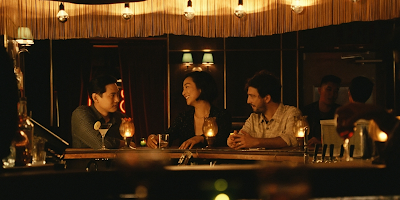
When Brody
finally published words on Past Lives there was one particular line
that I kept seeing passed around victoriously on Twitter by all those who had
been oh-so-rebelliously proclaiming the film “mid” for weeks and months before:
“But Past Lives is a movie of A students, by A students, for A students
so accustomed to analyzing works for their structure and their unities that
they connect around a movie that, apart from the actors’ own presences, offers
nothing else.” Brody again finds himself imagining a different, better version
of the movie he’s seen and using it to beat up on the actual film as it is; he
bristles at the too-clean structure and the underwritten characters, at a
strong story idea that doesn’t succeed in transferring the passions of those
behind the movie into the movie itself—“it’s a movie waiting to be realized.” The
film Brody imagines in his head may very well be, were it to exist for
comparison, a more edifying movie. But it doesn’t exist, and once again looking
at the film for what it actually is can lead us down some interesting paths of appreciation. The film’s carefully calibrated three-act structure, of equally
spaced time jumps from youth to young adulthood to adulthood, of clear thematic
and conceptual throughlines, need not be ungraciously attacked as some kind of
overly perfect cinematic schema that is more script than cinema. Why can’t a
film be structured so? Movies are not real life, so movies do not inherently
need to capture some kind of messiness that so often invades or even defines
our lives over any given number of years. The clear lines of Past Lives strike
me less as film school screenwriting tics than as signs of a certain structural
tenderness that works towards an overall gentility and maturity re: the nature
of time. And anyways—who cares about the script?? Anyone who speaks of a “good
script” or a “bad script” shouldn’t be let within fifty miles of film
criticism. Start your own genre of script criticism if you must, but don’t
bring that garbage over here. A film is a film, not a stack of paper with words
on it. Brody even gestures at this idea when mentioning that the only thing the
film offers is “the actors’ own presences”; but the concept of an underwritten
character is a fantasy, because what makes a character is what the camera sees
and what the microphone hears as it is trained upon the actor—presence, a
three-dimensional being, in all its material and emotional particularity, to
the degree that the filmmakers are able to capture it via their particular
style. Last year I tweeted out a vague thought related to Past Lives’
form by comparing it to one of my favorite films of last decade, Kogonoda’s Columbus
(2017), another film people took umbrage with for being too... formalized,
I guess is how I’ll put it. This isn’t a criticism to me; it’s a description. I
said that “I have a soft spot for stuff like Past Lives or Columbus, aestheticized
stillness, ‘obvious’ themes/emotions, similar to Netflix romance originals
where beautiful people w/script-induced problems are perfectly articulate
and/or movie-inarticulate.... It’s just another version of the
heightened/distorted/etc. reality that cinema can be.” I stand by this, because
so many criticisms of so many movies can be easily and freeingly dismissed by a
simple declaration that, “OK, cinema can be this, too.” And maybe Past Lives’
story concept was just too much catnip for me, but in the end I was moved by
the film’s patience, its visual tenderness, its mature handling of
fantasy/reality, and its contemplative, sit-and-stare approach to the
complexity that flows from life multiplied by time.
5. Barbie

...and now for
some real fun! The most enduring pleasure—or for many, pain—across the year on
film twitter was Brody popping up regularly to effusively praise Greta Gerwig’s
Barbie as the best thing since sliced bread, haters and naysayers (of
both himself and the movie) be damned. While I can’t go quite as far as
Brody here—the film landed at a high third place on his year-end list—I have
nothing but admiration for the way he bobbed and weaved with an Ali-esque grace
through a whole host of film critical fallacies that the movie inspired in many
other critics. Where many “serious” cinephiles found an apparently
self-explanatory and annoyingly pompous rallying cry in Amy Taubin’s succinct
hand-wave dismissal of the film (“It’s about a fucking doll”), Brody stood
behind the more mature and imaginative belief that meaningful, serious,
personal art could be made out of any subject—yes, even a doll. Others pointed to the fact that the film was
produced by the doll’s own manufacturer as some kind of obvious evidence that
it de facto could not be a serious film, and in fact was nothing more
than a “toy commercial,” whereas Brody saw an artist confronting her own
circumstances of art-making with subversive leaps of imagination in a film that
unashamedly addresses the real via the fake: “She doesn’t borrow pop culture
ironically; she embraces it passionately and directly, in order to transform
it, and thereby to transform viewer’s relationships to it and render that
relationship active, critical, non-nostalgic.” Part of Brody’s defense of the
film was also an impassioned defense of anti-realism, of the kind of stylish
fantasy that—because of its infinity of possibilities compared to realism’s—is
the stronger test of a filmmaker’s imaginative capacities. And I pretty much
agree that Gerwig passed the test with flying colors, albeit relatively
speaking; compared to something like, say, this year’s Beau Is Afraid, the
images/editing don’t inspire the same enraptured, mouth-agape awe in me. Even
Gerwig’s last effort, Little Women (2019), sings to me on a level of
montage that far outpaces not just Barbie, but almost all Hollywood
films of the last five years—yet, along with Lady Bird (2017), Brody for
some reason finds it a much lesser work. The substance of my own appreciation
of Barbie is, however, a few steps removed from Brody’s. Although many
commentators attempted to recruit the film into the culture wars as some kind
of ultra-feminist, radically anti-patriarchal text, tears were brought to my
(male) eyes more for the film’s complexly simple evocation of Being. Of
defining yourself not by being a man or a woman but by being a person who lives
in the world with other people. Of existing not to be reliant on but responsible
to those other people. (For me, the documentary analog to Barbie that I
would encourage everyone to seek out is the incredible Billie Eilish:
The World’s a Little Blurry [2021], a film that opens itself up to the
complexities of Living as a Human more than anything else in recent memory.) On the surface “I am Ken-ough” may have looked
like a cute slogan offered to wrap up a side character’s arc, but in the
trenches of the film it hit like the kind of motto that if taken to heart could
be a legitimate salve to gender relations. Maybe I’m a pushover (and if so,
glad to be one), but the film’s “cliché” closing montage through its punchline
ending felt like a moving paean to being human that called on the history of
non-human yearning in cinema from Disney’s Pinocchio to Spielberg’s A.I.
There were a couple dozen films I saw in 2023 that were more interesting
than Barbie (just to keep everything in perspective here), but few other
films produced more consistently short-sighted takes from the serious cinephile
set, which to someone who aims to rid cinephilia of such things was, although
not unexpected, somewhat disappointing. “But the film made a billion dollars,
it doesn’t need defenders!” The almighty dollar does not speak for me.
4. The Zone of Interest

From one of
Brody’s most loved to one of his most hated; another film which repeatedly set
online discourse aflame, and another one which made my brain ache for all the
critical fallacies which it inspired—more understandable fallacies, I will
grant, given the film’s serious and sensitive subject matter, and yet fallacies
all the same. Many of the negative reactions to the film, Brody’s included,
spout a similar refrain: that Glazer’s film doesn’t “pull it off.” What they’re
referring to of course is the film’s formal and conceptual conceit, which you’re
probably well aware of even if you haven’t actually seen the film. Herein lies
the problem: the vast majority of critiques aimed at the film seem to address
themselves to the film’s concept, what the film is on paper, rather than to the
film itself. This goes back to something I mentioned in the introduction to
this piece, which is essentially that movies are way more complex than we
subsequently pretend they are when we talk about them—there is way more
going on. For example, when critics talk about The Zone of Interest, they
mention the mise-en-scheme of immobile, surveillance-esque montage and the
film’s geographic relationship to the walls of the concentration camp, but I’ve
yet to see anyone pay detailed attention to the actual aesthetic substance of
the film’s images beyond their role in the conceptual program. Let’s merely
begin with the film’s opening shot, of the family lounging in swimwear on a
grassy hill above a lake, the camera seemingly hiding behind them in some tall
grass. Can we speak of the beauty of this shot? Of its simple, ontological
pleasure, of its sharp sound-image capturing of man in nature, of its
camera-stolen staged reality? (And then of course the complicated co-existence
of this beauty with the brutal ugliness of the surrounding goings-on, as underscored later in a river-bathing scene.) And as
the montage unfolds, can we speak of the pure visual and aesthetic interest of
this bold editing blueprint? Of the totally fascinating cinematic pleasure of
things like, say, the avant-garde collage of flowers at one point (recalling
another of the year’s boldest films, Paul Schrader’s Master Gardener)? The
movie cannot be approached just on the level of idea—it must be grappled
with on the level of material, cinematic reality. Brody, like others (even
those who responded positively), watches the movie and then produces his read
on what it does (and his problems with said doings) as though it were a
simple matter of film critical math, Glazer’s apparent intentions neatly added
into the equation. (A quick Googling of “the intentional fallacy” would do good
for many here, by the way.) “Showing off hands kept knowingly clean is no less
vain or vulgar than getting them naïvely dirty,” writes Brody of the
“faux-abstinence” of the film in a tweet inspired by flipping the idea behind Serge
Daney’s famous “Tracking Shot in Kapo” essay. We’re again at a point where I
think it would be more edifying for people if they simply let the film be what
it is without accusing it of posturing. I haven’t read a lot from the film’s
makers, but it may very well be that Glazer’s stated intentions were misguided
from the get go or were unsuccessfully realized. However, the film is its own
beast, and lives and breathes on its own, apart from its makers, on the screen,
for those who view it. Like for me, who came away from it with the impression
that the film basically amounted to a simple family drama—dad is forced to take
a new position in his company and has to work away from home for a while—made
fascinating and involving and complicated by its incredibly specific historical context.
Part of the problem for many viewers, I am guessing, stems from an
understandable inability to grant human three-dimensionality (and therefore any
shred of empathy) to historical characters that represent, culturally, the
personification of evil. But if total moral complexity is allowed to stay, one grants
oneself a more dense film, and the resulting feeling of confusion and sadness
in the face of quotidian moral failings is more robustly human. The film’s
audacious jump to the modern day utterly moved me, in a juxtaposition that does
as much to complicate our relationship to history as the more well-received coda
of Killers of the Flower Moon. So in the end, I walked away having
experienced a serious work of art rather than merely some kind of intellectual art
installation. The mélange of carefully calibrated artfulness and unsentimental
moral reckoning made the film a thrilling alien object that shook me to a rare
and unique degree.
3. The Holdovers

Much of the
criticism directed at The Holdovers involves Alexander Payne’s decision
to not only set the film at the beginning of the 1970s but to also give it the
veneer of the kind of movie made back then. The “they don’t make ‘em like this
anymore” appraisals wrote themselves, and in turn so did criticisms of the
film’s perceived nostalgia. “Not only does this hermetically sealed,
historically reduced drama falsify the times in which the movie is set, it
falsifies the characters and turns them into automata of the plot’s mechanism,”
writes Brody. The real core of the movie’s nostalgia is “a cinematic nostalgia
for an earlier generation’s coddled mainstream, one fabricated by Hollywood’s
calculated suppression of whatever might risk controversy too wide or serious
to be monetized.” As is a recurring theme here, Brody spends a whole paragraph
listing things he thought should have been in the movie, such as the
various political ferments circa 1970 that “it was impossible to be alive, even
as a teenager, and not be aware of....” I won’t rehash my argument against such
critical maneuvers, so I’ll just say that if Brody wants to direct a movie so
bad, he should(—again; to anyone with a file of 1995’s Liability Crisis, my
DMs are wiiiiide open.) Part of the problem is taking Payne’s gesture of
setting his film when he does and making it look like what he does in bad
faith. Brody posits that the film “returns to a way of telling a story that
reflects what, to Payne, comes off as a simpler, clearer, perhaps more humane
time.” Regardless of what I think Payne’s reasoning behind his decision was,
the film bears out a human complexity on the level of story and character and
environment that makes such a statement appear unfair. Payne has more than
acquitted himself in telling a modern day story—The Descendants (2011)
and Nebraska (2013) are both contemporary classics—and even a futuristic
one with Downsizing (2017), and all of these films contain the same
attention to detail in story and character and environment as The Holdovers.
But I do think a 1970-set drama blanketed by a sheen of faux-film grain does
allow for a certain purifying of all these things, a removal of
distractions of sorts, so as to really, truly get down to the business of
telling a complex story on a movie screen, where that story and its complexity
is all that matters. Brody is spot-on when he says that “the movie is a pile of
clichés reprocessed with such loving immediacy that it feels as if Payne were
discovering them for himself.” À la another director who debuted in the ‘90s, James
Gray, Payne shows an uncommon and old-fashioned dedication to the art of
storytelling that is decidedly unsexy. First time feature film writer David
Hemingson provides a script that is classically shapen and which doles out
character information parallel to the film’s progression, in Good Script
fashion. We saw Brody call the characters “automata of the plot’s mechanism,”
and in the sense that is absolutely true—but I can’t use it as a pejorative,
because this is simply how much great cinema, especially classic Hollywood
cinema, works: characters follow a predetermined path from the beginning of a
movie to the end of a movie. (There are other types of movies, and those are
great too, but it doesn’t make these not great as well.) Of all the Best
Picture nominees, The Holdovers is in a sense the least original; but in
another sense it’s one of the most radical. To make another Gray comparison,
Payne’s art here is not in wowing us with the new, but reacquainting us with
the old, at a deeper level—he actively doubles down on what came before, and as
a result, inherently produces something new. Contributing to the newness is the
simple fact that it is 2023, not 1970, and the film is not actually shot
on film, but merely a digital facsimile of it. The act is not quite as radical and
rewarding as that of, say, Mank (2020)—which merely claimed to copy 1930s
movies on its way to looking like nothing else has ever looked—but it still
creates a dissonance with modern moviegoing that forces the contemporary viewer
into a new mode of seeing and hearing, and thus perhaps a new way of
being-with-a-film, one that’s more still and slow and pushes you into
engagement with the film (and by extension, life) at a more thoroughly enveloping
level. Ultimately The Holdovers was 2023’s humblest film this side of
Hong Sang-soo, and thus for me a radical gesture, not only cinematically but
existentially. It rewards a sensitivity to movie- and life-things in the way
the best films always do.
2. Killers of the Flower Moon

Scorsese’s
latest groundshaking opus was Brody’s #1 movie of the year when it came time
for list-making, so I’ve been afforded a rare opportunity to tag team with him
re: this film’s thunderous greatness before we end this little exercise at a
final site of disagreement. The enormous amount of movie Killers of the
Flower Moon contains within its brisk three-and-a-half hours is appropriate
for the enormity of the subject that Scorsese tackles, which is basically
nothing less than injustice itself, and history’s forgetting and/or
exploitation of it. The film’s story sprawls across its American landscape and
into every pocket of Osage County’s population, roaming from its newly wealthy
Native people to the white settlers who’ve arrived to strip it from them and
everything in between. The teeming sense of a community on the brink of and in
the midst of uninvestigated tragedy is as rich and detailed and unique a
creation as American cinema has ever seen thanks to Apple’s generous $200
million loan to one of the premiere artists in the world of film art going back
fifty years. The film is astoundingly watchable while still striking a
fascinatingly unique chord in the history of megabudget mise-en-scène—this
could very well be the formal and moral endpoint of Scorsese’s run of gangster/gangster-adjacent
films going back to Goodfellas (1990) and through Casino (1995), Gangs
of New York (2002), The Departed (2006), The Wolf of Wall Street (2013),
and The Irishman (2019), the last of which heralded this end-of-career downshift
away from the vivacious thrills & kills mentality of those earlier films
and towards a more haunted register of trans-historical sadness. The kills in Killers
are absolutely numb, totally gleeless, unglamorized, and dully hyper-material,
scored by silence—the sound of a gunshot and a body slumped to the dirt. There
isn’t even a hint of vicarious thrill; indeed, they actively hurt to witness,
and the way Scorsese and longtime editor / fellow octogenarian Thelma
Schoonmaker cut to them unlinearly in the midst of the unfolding quotidian
horrors is a brutal and bitter artistic choice. Killers of the Flower Moon is
not a traditional movie in any sense beyond its basic Griffith-descended film
grammar (in fact the mass of characters and extras dodging in and out of
Rodrigo Prieto’s camera frame feels like something out of The Pigs of
Musketeer Alley, given the period setting); the performances by dual
Scorsese legends DiCaprio and DeNiro are ungainly, actorly creations of complex
near-mugging that play on both stars’ talent for bumbling charm, which feed
into a movie-wide contrast between the whites and natives, whose performances
are furiously and calmly naturalistic, as led by Lily Gladstone. What this
contributes to is a deeply complex rendering of human nature uneasily
summarized or explained, which is appropriate for an historical tale that defies
our common sense understanding of what people are capable of—hence the difficulty
for some in being “convinced” by the central portrait of a marriage, as little
of it is spelled out beyond the bodies and faces and voices of DiCaprio and
Gladstone. “The movie doesn’t explain what Mollie is thinking while her sisters
are dying young,” writes Brody, “or while she’s getting sicker during Ernest’s
treatments. It doesn’t explain what Ernest thinks when he’s first put up to
nonviolent crime and then is dispatched on lethal errands. The character
psychology of Killers of the Flower Moon is minimal—because Scorsese
instead presses its action furiously, urgently, onto the screen as if it were
something like dramatized documentary in the first person, his own bearing of
witness.” Part of what I find fascinating about the film’s form is its
similarity to the kind of docudrama series one might find on, say, the History Channel,
all while still being supremely cinematic—soaring drone shots over masses of
cattle and oil fields, landscape shots of flowers and dancing natives, etc. While
retaining the complexity of a movie, Scorsese explicitly makes a moral history
lesson, something that educates as much as (if not more than) it entertains. Hence
why Scorsese’s final cameo is so meaningful and moving, for all the obvious
reasons and more; it transcends the film and direct-addresses the audience in a
way that both does and does not break the fourth wall, speaking to history and
to the present, to both the audience and himself, with a dead-serious
compassion that is all the more heartbreaking because, for the people it
commemorates, it comes a century too
late. Such is living through history, and with this film Scorsese has written
it with not just lightning but thunder as well. I left the theater shocked and
shaken, and knowing that no words would do it justice, just as these haven’t.
1. Oppenheimer

I don’t even
know where to start with this one, as Brody is so wrong on so many counts, and
this film is so magnificent in so many ways. You know what? Maybe I’ll just
leave him out of this one, because at a certain point there’s no use either
reading or reacting to criticism that flat out does not respect the film in
front of them as the film in front of them. We’ve already seen this
before, and it’s maybe Brody’s favorite fallacy to try and get away with. But
that won’t fly here. Here is a quote that wins the prize of most outlandish thing
I’ve read from him as part of this little project: “For long stretches of the
film, Nolan’s direction is a merely literal depiction of actors dispensing
dialogue with efficiency but without flair; if his name weren’t attached,
the direction might well be ascribed to a serial-television journeyman.”
(Emphasis mine.) What? What?! Oppenheimer only represents maybe the most
serious attempt at Soviet montage at a big budget level in the history of
modern American cinema, but sure, what you said. “The movie is as sluggish as
if Nolan were underlining the script’s most salient passages onscreen, and,
with a more vigorous pace, it could have amplified the script without adding a
minute of screentime.” Yeah, sure—a three-hour long historical biopic 50% of
which is in black & white made close to a billion US dollars despite being “sluggish”
and not having a “vigorous pace.” What film was being watched? Nolan and editor
Jennifer Lame only went into another artistic stratosphere to conjure up a
project with such immaculate rhythm and pacing that it is nothing less than
pure visual music from IMAX frame #1 on. The opening fifteen minutes or so is already
maybe the most iconic editing sequence in recent cultural memory, and rightly
so: Nolan intersperses young Oppenheimer’s school years with subatomic visions,
and his artistic and scientific intake with scenes of a troubled mind straining
towards the bleeding edge of intellectual modernity. Despite its incredibly dense
wordiness at times, Oppenheimer takes an image-first (and cut-second) approach
to cinematic storytelling. Cillian Murphy’s face becomes it’s own vast and
infinite terrain as close-ups turn into abstract portraits (like the Picasso he
views in the abovementioned sequence) and reaction shots become glimpses into not
just emotion but soul and conscience. Nolan stages a drama both immense and
intimate via the counterintuitive use of bulky 65 mm IMAX film on a by-all-accounts
high-focus high-paced shoot. The energy and vitality of every single filmed
moment is astonishing. The film is, in one word, a symphony. Nolan’s ambitions
have only been growing and his art has kept up with him every step of the way. Everything
is bolder; more intuitive. Each cut speeds into the next with a confidence and a
purpose that would make Eisenstein and Griffith lock eyes from across a hypothetical
screening room. The film’s play with time and competing perspectives ricochets
into a complex web of drama that accumulates morsel after morsel of emotional
and intellectual information in order to reconstruct the man Robert J. Oppenehimer
via cinematic mosaic, all while still letting him remain enigmatic, an Other
that we will never be able to fully access, a man of contradiction and paradox
and nuance. The world doesn’t like complicated people. And vice versa: people
don’t like a complicated world. And yet Nolan graphs as much world-historical
complexity as he can muster onto this story of the bomb and the man who made it,
from the tiniest invisible details all the way to a God’s eye view of a planet
racing towards self-destruction. At the end of the day cinema has nothing to do
with critics or criticism; it’s about sitting down in front of a film like this
and giving yourself over to it, mind body and spirit, and letting every last
inch of whatever aesthetic, intellectual, or spiritual edification it contains make
full-force impact with every last inch of who you are as an irreducibly complex
human being. That fusion is what it’s all about, and the fusion between me and Oppenheimer
back in the summer of 2023 happened to be hands down one of the most electrifying
experiences of my movie-going year. And sure, I look forward with mild
amusement to receiving a stream of second- and third-hand news Monday morning
about all the gold this took home.
.....
Now that you’ve
made it this far (or skipped down—no offense taken), here are my own hypothetical
Oscar picks, in as many categories as I could reasonably fill, from all the
films that first became available to me to legally see from January 1 through
December 31, 2023 (sorry for the extra spacing, I can't for the life of me figure out how to fix it):
Best Picture:
Beau Is Afraid
in
water
The Killer
Killers of the
Flower Moon
The Lost King
Master
Gardener
May December
Oppenheimer
Pacifiction
Best Director:
Wes Anderson –
Asteroid City
Hong Sang-soo –
in water
Christopher
Nolan – Oppenheimer
Paul Schrader –
Master Gardener
Martin
Scorsese – Killers of the Flower Moon
Best Actor:
Michael Cera –
The Adults
Leonardo
DiCaprio – Killers of the Flower Moon
Michael Fassbender
– The Killer
Thomas
Schubert – Afire
Keifer Sutherland
– The Caine Mutiny Court-Martial
Best
Supporting Actor:
Jason Clarke –
The Caine Mutiny Court-Martial
Robert Downey
Jr. – Oppenheimer
Jacob Elordi –
Priscilla
Glenn Howerton
– BlackBerry
Charles Melton
– May December
Best Actress:
Lily Gladstone
– Killers of the Flower Moon
Natalie
Portman – May December
Talia Ryder – The
Sweet East
Cailee Spaeny –
Priscilla
Sophie
Thatcher – The Boogeyman
Best Supporting
Actress:
Haily Atwell –
Mission: Impossible – Dead Reckoning Part One
Maeve Courtier-Lilley
– Gran Turismo
Mia Goth – Infinity
Pool
Hannah Gross –
The Adults
Quintessa
Swindell – Master Gardener
Best Original
Screenplay:
Wes Anderson –
Asteroid City
Laura
Citarella & Laura Paredes – Trenque Lauquen
Christian
Petzold – Afire
Nick Pinkerton
– The Sweet East
Paul Schrader –
Master Gardener
Best Adapted
Screenplay:
Wes Anderson –
The Wonderful Story of Henry Sugar
Steve Coogan
& Jeff Pope – The Lost King
William Friedkin
– The Caine Mutiny Court-Martial
Matt Johnson
& Matthew Miller – BlackBerry
Christopher
Nolan – Oppenheimer
Best Cinematography:
Xavi Giménez –
Marlowe
Hong Sang-soo –
in water
Hoyte van
Hoytema – Oppenheimer
Artur Tort – Pacifiction
Łukasz Żal – The
Zone of Interest
Best Film
Editing:
James
Vanewater – Infinity Pool
Kirk Baxter – The
Killer
Thelma Schoonmaker
– Killers of the Flower Moon
Jennifer Lame –
Oppenheimer
Sarah Flack – Priscilla
Best Sound:
The Exorcist:
Believer
Ferrari
The Killer
Oppenheimer
The Zone of
Interest
Best Visual
Effects:
Beau Is Afraid
Gran Turismo
Infinity Pool
The Killer
Rebel
Moon: Part One – A Child of Fire
Best Production
Design:
Asteriod City
Beau Is Afraid
Killers of the
Flower Moon
The
Wonderful Story of Henry Sugar
Oppenheimer
Best Original
Score:
Joe Hisaishi –
The Boy and the Heron
Hong Sang-soo –
in water / Walk Up
Devonté Hynes –
Master Gardener
Trent Reznor
& Atticus Ross – The Killer
Robbie
Robertson – Killers of the Flower Moon
Best Original
Song:
“Dear Alien
(Who Art in Heaven)” – Cast, Asteroid City
“Evening
Mirror” – Paul Grimstad & Talia Ryder, The Sweet East
"Speed Drive" – Charli XCX, Barbie
“What Was I Made For?” – Billie Eilish, Barbie
voicemail birthday
song – Shin Seok-ho, in water
Best International
Film:
Afire
Fallen Leaves
in
water
Pacifiction
Scarlet
Best Animated
Film:
The Boy
and the Heron
Best Documentary:
De
humani corporis fabrica
Godard Cinema
The History of
the Minnesota Vikings
Best Short
Film:
The Daughters
of Fire
Passing Time
The Swan
Trailer of the
Film That Will Never Exist: ‘Phony Wars’
The Wonderful Story of Henry Sugar