ART, IF I MAY USE THAT DIRTY WORD
On Little Odessa (1994)


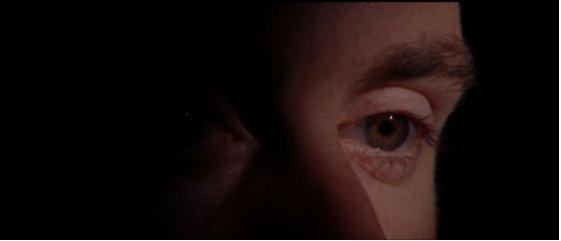
It's as if Tim Roth emerges, for this particular story, from some primordial arena of darkness and drama and feeling, and this softly rising music is some kind of primordial lullaby—as if his face, half-illuminated, does not exist anywhere in the chronology of the narrative, beginning, middle, or end, but nevertheless serves as both prelude and foreshadowed endpoint, the locus of emotion which everything will circle back to again and again. For the same shot repeats itself, slightly altered, as the closing image of the film. In some ways it merely suggests the transfer of this face, this man, this soul, from one realm of things to another—from the primordial soup of drama and emotion to the specific situation of the film Little Odessa: New York, Brighton Beach, early 1990s, etc.
It’s not a half-bad metaphor for the way James Gray conceives his movies, which merely consist of ancient and universal storytelling tropes filtered through an intensely personal microcosm. “Tropes,” that is, without the pejorative connotations—in other words, ideas tried and tested by thousands of years of human history and art and culture. In the case of Little Odessa, we get a variation on the prodigal son story crossed with some parental archetypes—the stern father, the dying mother. These types get filled in with specific character details pertinent to Gray’s desire for emotional autobiography, but they never lose their mythical weight.
Let’s stop for a moment to introduce one of the many clichés that, in Gray’s cinema, become renewed, resurrected, revivified:
The idea, in art, of achieving the universal through the personal.
Just writing these words down, and so probably reading them too, feels boring and unoriginal and uninsightful. But hopefully at some point in this sustained look at the cinema of James Gray it will begin to sink in, when one really ponders it, when one really experiences it, when one really becomes vulnerable to it—just how profound this idea really is.
But let’s take a step back and see how we got here....
__
Cowboys and Angels (1991), Gray’s graduating student
short film at USC, had been a hit. Meaning it had caught the eye of people who
could make things happen. One of these people was Jeremy Zimmer, of the United
Talent Agency, who, having been tipped to the film, saw it at the graduate
screening and, being reminded of several of his favorite 70s directors, decided
to meet with Gray. They hit it off and Gray was signed to the talent agency—the
first student filmmaker Zimmer had hired in years. Also impressed by the film
was producer Paul Webster, whose assistant had been sent to watch the USC
student films while searching for new talent to mature at his production
company Working Title Films; the report came back that Gray’s film was the only
one worth seeing, so Webster did, and he found in it an “honesty and visual
power that seemed to be lacking in everything else I saw.” He offered to make a
movie with Gray.
What movie that was going to be,
however, was still an open question. Sticking around in Los Angeles after
graduation, Gray was afforded some time to consider his options by the
(un)timely demise of his grandmother; she had died the year before and left him
around $28,000—more than he’d ever had, and enough to live off of for a year
without having to work. That year was mostly spent reading scripts and then,
sensing their unviability, thinking up his own.
Webster and Zimmer sent him potential
script after potential script, but none of them suited Gray’s desire to avoid
cliché and control the material himself—“I’d read the first four words of the
script, and I’d throw it in the corner.” About four months in Gray realized
that if he was ever going to get a script he liked, he’d have to write it
himself. But writing a good screenplay couldn’t just be a tossed off
prerequisite to filming; for Gray, it had to be approached with the same focus
and dedication as filmmaking itself. So he became obsessed with becoming a good
screenwriter, and knowing that his first script probably wouldn’t be worth
making, he essentially ended up writing two in preparation for writing the
thing he would actually make.
One of these was called Mecca, a
script co-written with school friend Ethan Gross (future Ad Astra co-writer)
about the disco era '70s record industry. It was an ambitious rise-and-fall
story of record executive Neil Bogart, founder of Casablanca Records—a “very
serious movie, about permissiveness without purpose, and self-destruction and a
number of things,” per Gray. The script was finished in January 1992 but the
calls kept coming in from people saying they were passing on it; eventually it
was optioned by Universal (at $130,000) for director Rob Weiss, but was never
made, by him or anybody else (and eventually made redundant, for Gray, by the
existence of friend Paul Thomas Anderson’s Boogie Nights). Regardless,
the option earned enough money to keep Gray afloat for another eight or nine
months, enough time to start and finish a more personal script that would
become Little Odessa.
Webster’s suggestion to Gray—that he
simply tell the story of his family relationships with a genre element thrown
in—worked to get him started. He came at the story backward: he read in the LA
Times about the Russian mafia and how they were stationed in both Fairfax
(a California town just north of San Francisco, and where the film’s opening
assassination was shot) and Brighton Beach (a Brooklyn neighborhood not far
from Queens in New York). The latter was close enough to home to stand in for
the milieu of Gray’s childhood, and the prodigal son structure of the story
eventually took on all the contours and textures of Gray’s personal experiences
from before and after he had left for college four years earlier. The big
themes that fascinated Gray at the time: “youthful alienation and emotional
stultification.” Within three months after leaving for USC, Gray’s mother had
died of brain cancer, his brother had moved out, and his father was left alone
facing a traumatic and emotional situation—and soon to face his own legal and
financial troubles culminating in a 56 count indictment against his train parts
company in 1991. “Almost overnight, the family unit was destroyed.” The script,
and then film, that found its way into the world out of this era of Gray’s life
seems to contain the density of all of this; every feeling and emotion of
nearly six years-worth of life experience crammed into the span of just over 90
minutes.
Story planning, structuring, and a
detailed treatment for Little Odessa took Gray around four to six months
to complete; the actual script was then written in around two or three weeks
and was finished in November 1992.
That same month saw the script sent to
Tim Roth; Gray had loved his performance in Robert Altman’s Vincent &
Theo (1990), and Roth was a fellow member of Zimmer’s talent agency to boot.
He loved the script and signed onto the project after a successful lunch
meeting with Gray and Webster, and then sent the script to independent producer
Nick Wechsler (a partner in the L.A.-based talent management firm Addis
Wechsler) who joined the project as executive producer. The luster and
credibility he brought to the project, along with Roth’s acting profile, was
enough to attract other actors and financing. Half of the budget came from Live
Entertainment (for domestic distribution rights) and the other half from New
Line Cinema (for foreign rights)—just a few million dollars total. After Roth,
the main actors started filling in: Edward Furlong and Moira Kelly[1], then Maximilian Schell[2] and Vanessa Redgrave[3]. The rest of the cast,
plus extras, were almost exclusively taken from local-born residents of
Brighton Beach.
Even with a name like Roth’s aboard,
the addition of Furlong became instrumental in getting the film financed and
made. He had read the script and really wanted to be in it, and he had just
come off of co-starring with Arnold Schwarzenegger in the highest grossing film
of 1991, Terminator 2: Judgement Day, which of course meant something to
the money people; Gray was puzzled after seeing Cameron’s film—this Furlong kid
wasn’t the Jean-Pierre Leaud from The 400 Blows type kid Gray was
looking for. But as will be a common thread with Gray’s first movie, the
circumstances dictated a change in conception for the good: Gray “wound up
loving him.” He was actually of Russian descent and had a face like a young
Alain Delon[4]—perfect
for infusing the character and the film with a certain European severity. As
the ostensible stand-in for a young James Gray in this tale only a few steps
removed from the autobiographical, Furlong’s introversion and quiet intensity play
as the representation of the internal Gray rather than the external Gray—more
of an extrovert and also something of a class clown in his youth.
But here—and more and more as Gray
matures as a filmmaker—an overreliance on external facts will be avoided for an
attempt at pure and unfiltered emotional autobiography.


__


A few minutes into Little Odessa we
see James Gray paint his first self-portrait—young, at the movies, leaning back
in his seat and staring up at the final reel of the projected film. Legs up,
cigarette in hand, theatre all but empty. It could be an Edward Hopper
painting. Such autobiographical touches will never fully disappear from Gray’s
work, but it’s safe to say that of his films to date none (until his newest, it seems) has so thoroughly—and
so nakedly—utilized true-to-life elements as straightforwardly as Little
Odessa. The dying mother, the stern father, the absent brother—all would be
drawn directly from Gray’s life. His characters are stand-ins of a sort,
15-year-old Edward Furlong being the first of many to not so secretly play some
kind of fictionalized version of Gray (a role later to be filled, in each’s own
specific way, by Mark Whalberg, Joaquin Phoenix [thrice], Charlie Hunnam, and
Brad Pitt). But there will never be a neat one-to-one ratio of character to
filmmaker, at least not in any straightforward way. It will be the films
themselves, rather than the characters, that will ultimately be the conduit for
those intimate impressions that Gray will dedicate his filmmaking career to
expressing on screen.
The film we see Furlong watching in Little
Odessa is the Burt Lancaster western Vengeance Valley (1951). Its
selection for appearance in the film has a hint of the arbitrary—Gray
originally wanted the Clint Eastwood western Hang ‘Em High (1968) but
couldn’t get the rights; Lancaster was a favorite of Gray’s, it was a western,
and most importantly for the producers it was in the public domain—but the
selected excerpt could hardly be more appropriate. In its most basic form the
film is a tale of two brothers, a diagnosis of their relation to each other through
their relation to their father; storytelling at its most elemental. The snippet
we see, of Lancaster forced to shoot down his own brother, and words of their
father’s regret—“You didn’t kill him. I did. Long time ago. The day I looked
away and hoped he’d change”—does its part to foreshadow the generational conflict
and pain of the story we’re about to see unfold. The texture of fraternal
relations, the hints of patricidal urges—transplanted to the immigrant Russian
milieu of Little Odessa, the Dostoevskian motifs of The Brothers
Karamazov (1880) veritably bubble to the surface.
Or to borrow another reference from 19th century Russian literature: Ivan Turgenev’s Fathers and Sons (1862), the
title of which doubles for what will surely go down as one of it not the central
theme of Gray’s cinema. For a body of work that is obsessed with such elemental
family relationships—in Gray’s words, “the locus of wonderful emotional
support, but also of great pain”—Little Odessa is perhaps the film that
cuts closest to the bone where that subject is concerned. As such, the
pervading mood of the film as an art object is clearly a certain heaviness, a
heaviness of emotion, atmosphere, mood—it hangs like a wet blanket over the
whole film. It’s the kind of weight that feels more akin to our idea of a 19th century Russian tome than to anyone’s idea of an early ‘90s American
independent movie. Using this era of supreme artistic excellence as a reference
is apt for a film whose existence could be a gloss on the opening line of
Tolstoy’s Anna Karenina (1878): “Happy families are all alike;
every unhappy family is unhappy in its own way.” The Shapiro family of Little
Odessa falls into the latter category, and the novelistic depth with which
the film dramatizes the moral and emotional complexity of its Russian-American
milieu becomes all the more amazing considering it’s fit into a sub-100 minute
runtime. But this apparent thematic grandeur is balanced with a termitic
Dostoevskian streak which runs throughout Gray’s entire filmography, but is
nowhere more physically palpable than here: cramped interiors, wintry
landscapes, the oppressive atmosphere (seen by some as suffocating, but isn’t
that kind of the point?), plus the already mentioned patricidal urges. Although
if there’s an important difference between the film and its literary forbears,
it’s in the film’s silences—a specialty of cinema that literature can really only
gesture towards, never quite embody. The fervid loquaciousness of the
characters in those Russian novels is done away with, and is replaced with a
deep and abiding lack of communication. In the Shapiro household, the
grandmother mostly speaks Yiddish, the parents mostly Russian, and the sons mostly
English; there is a gulf between generations and the sense that, the further
one is from one’s historical roots, the more one is unable to connect not only
with the essence of one’s heritage, but with the very family members sitting in
the next room.
But this pervasive heaviness and
incommunicativeness is but one half of the paradox Gray speaks of. For as much
as sadness is the central emotional mood of the picture, and as much as the
impossibility of communication is a central theme, neither of these things can
cover up the moments of great tenderness and love that exist between the
members of the family, exist as they do in forms ranging from apparent
bullishness to genuine tenderness. The scenes of Vanessa Redgrave with her
children—even estranged contract killer Tim Roth, back home for a job—are bathed
in an unspoken or whispered gentleness. Roth’s scenes with Furlong, on the
other hand, traffic in a different kind of tenderness, one that can only show
itself in a softened form of violence: a slap to the face, a push to the
ground, a harsh word (or silent bonding at an indifferent screening of A
Nightmare on Elm Street 4: The Dream Master). The hardness of Roth’s
character is not incompatible with a certain kind of love—one senses early and
often his genuine care for his younger brother, and his desire to see his
mother again before she dies trumps his hatred of the father he must make a
truce with to do so—but as a character he is all externals; closed-off,
emotionally invulnerable, his leather jacket worn like an impregnable suit of
armor.


And we see here for the first time in
Gray that this loneliness—seemingly omnipresent and inescapable—is always at
least partially a loneliness determined by familial and social forces outside
of one’s control. Furlong is lonely because his mother is sick, his brother is
gone, his father is to be feared. Schell is lonely because his son is “dead,” his wife soon to be, his other son but a reminder of the first. It’s implied
(“so he gets what I got?”) that Roth was led to self-exile by his father’s
beating of him. The texture of the film (and the literal film it’s shot on),
and the winter snow, and the intense cold palpable on the screen, is but a
perfect metaphor offered up by nature to the predicaments of these particular
inhabitants of it.
So there aren’t any villains in Gray’s
cinema. Roth’s killer, or Schell’s father, for all their wrong-doing, are still
eminently human. Their weaknesses explainable by a combination of inherent
human flaws and larger social determinants, Gray has nothing but love for
them—the blame, if it is put anywhere, is on the greater world around them.
Most often it’s class. Or fate, which for Gray is really another way of saying
the same thing.
Neither, alas, totally avoidable. More
so for immigrants, and Little Odessa takes up the immigrant theme twenty
years before Gray would make a film with that as the title. He locates this as
one of the subjects of the film: “what it is to emotionally suppress being
Russian, to be Jewish, the incredible paranoia that is linked to previous
persecutions and which, in a strange way, leads to a lack of openness.” Gray’s
Russian-Jewish heritage itself is a subject of the film, and he speaks of it
through the film as though neither half of that hyphenate were fully there—that
the Jewishness would be lost in Russia and the Russianness would be lost in
America, and “they wind up in a kind of nether world.” Schell’s character also
represents a third lost aspect, that of the disappearance of the Russian
intelligentsia in America. Many Russian intellectuals had lost their posts by immigrating
to America and, given the language or cultural barrier, had nowhere to go with
their gifts. Professors, artists, scientists were forced to become plumbers,
taxi drivers, shop owners. In Little Odessa Schell runs a newspaper
stand but admits to reading Crime and Punishment to his children,
playing them Mozart (Schell himself was an accomplished pianist), and has
abstract art hanging in his apartment.
The neighborhood of “Little Odessa”
itself—a nickname for Brighton Beach taken from the Ukrainian port city of
Odessa—is an enclave of Russian and Eastern-European immigrants. An early-'70s
détente between Brezhnev’s USSR and the U.S. saw a wave of immigrants in the
form of several thousand Russian Jews settling on the south Brooklyn sea line in
New York. For the purposes of the film, it’s more or less a place where the
American Dream comes to die. The reality of the American immigrant experience
is just one layer among many that contributes to Little Odessa’s near
suffocating atmosphere; there’s no room for the concept of the American success
story, all hard work and good luck, to breathe here. To put it more
sensorially: the Shapiro household smells like death, literally and
figuratively. One could say that the pervading atmosphere of the film is but an
extension of the mood of the apartment, which is but a transplantation of the
moods of Gray’s childhood. Cramped, cluttered, claustrophobic quarters; narrow
hallways, wallpaper, carpeting, pictures everywhere—all so strongly and
specifically evocative that the setting itself is elevated to a theme.
The emotional tenor of the film may
have its roots in Gray’s memories (“I had tried to put my grandparents, and my
parents, into the movie as much as I could”) but its articulation and
realization on every level of the film appears as a clear and somber expression
of Gray’s artistic inclinations (with a dash of cosmic luck sprinkled in). Cinematographer
Tom Richmond was Gray’s right-hand man in achieving the look and the feel of
the film. Gray, former wannabe painter, had done 75 watercolor storyboards for
the film and gave them to Richmond to consult. They also went, along with
production designer Kevin Thompson, to the Metropolitan Museum of Art and the
Museum of Modern Art in order to look at paintings and art books—some Edward
Hopper, some Max Beckmann, the early-'70s street photography of Helen Leavitt,
plus a bunch of Renaissance and religious paintings. Gray also made Richmond a
tape of Russian choral music, which he would then walk around New York
listening to, collecting moods and ambiences and atmospheres in order to get a
flavor of the landscape and establish ideas for the movie.


Getting script to screen ultimately
became more of a transformation than a translation. To introduce perhaps the
most important theme of Little Odessa’s shoot—that style would be
dictated by constraints, budgetary and otherwise—is the fact that the film was
shot in the worst winter in New York City recorded history up to that point. The
24 day shoot that began in March 1993 would be fatefully beset by inclement
weather. Seven or eight major snowstorms over the course of the shoot plus
temperatures often reaching -20 F resulted in a set of constant, forced
improvisation (and a multiple-day crew-wide snowball fight)—all this for a film
that Gray had originally written to take place in summer.[5] However, what started as a
massive hindrance became, after the first beautiful snowy rushes, the rule of
the shoot: whenever it was snowing, go and shoot outside. Locations needing to
be cleared of snow caused major time losses, prompting Gray and crew to adopt a
philosophy of simplicity as regarded how the film was to be shot: “to reduce it
to what he really needed.” So the decision was made to shoot much of the film
in elaborate master shots—scene-surveying medium or long shots usually
encompassing all the actors in a scene, easy to cut together in the editing
room (in which the same principle of simplicity presided) due to the lack of
coverage shooting. Indeed, it ended up taking only six weeks to cut the film
together in the editing suite.


The shape and gait of the film is very
much characterized by a deliberateness, as much a reaction against styles in
vogue at the time as it is the manifestation of a worldview. The film embodies
its ideas; the film is its form: a slow march toward death, towards the
unavoidable, towards tragedy. Each cut seems to precipitate the arrival of a
new shade of sadness; two-shots seem to emphasize only the distance between
characters; close-ups seem to discover only the most melancholic aspects of the
human face; long shots seem to represent only the widest gap between the dramas
of these people and the goings on of the world at large. The subtle movements
of fate leading to the narrative’s conclusion are pre-figured by a heavy use of
zooms—“slow, almost imperceptible zooms,” according to Gray, which he finds
“very cinematic because there’s no equivalent to it in real life.” They’re also
clever formal tools that add dramatic weight to even the simplest of shots:
take the scene-long zoom-in on Tim Roth’s face in the gas
station—simultaneously a choice dictated by constraints (time for getting
adequate reverse shots of his interlocutors was limited) and by artistic theft
(it’s an idea stolen from the slow zoom-in on Al Pacino’s face in The
Godfather when he discusses his plan to kill Sollozzo and McCluskey).


If one wished, this master shot
aesthetic—again, partially dictated by time constraints—could still very well
be analyzed on the basis of Bazinian ontology, its observational respect for
the “real” as a democratization of the image, allowing the viewer’s eye to roam
at their own volition. No hardline stance against deep-focus realism’s “opposite,”
montage filmmaking, is intended at all. But appreciation for Gray’s reluctance
to cut unnecessarily and his dedication to a certain type of realism can be
bolstered by reference to a certain tradition of filmmaking that prizes the
capturing of reality (if inherently non-objectively than at least with a
notable resistance to disturbing it) above its reordering or its eradication.
An appreciative absorption of the philosophies of neorealism is no surprise
coming from a director who’s on record claiming that “Italian cinema from 1945
to 1980 is the greatest stretch of national cinema in the history of the
world.” But if Gray’s cinema traffics in a certain kind of American neorealism
(at least through his first four films), it’s one that comes not from a desire
for realism at all costs but from an attempt to capture on film something of
the rhythms and textures of Gray’s subjective experiences of the world. And
from realism arises ambiguity—because that’s the way the world works. But this
is a lesson transmitted to Gray the filmmaker not directly from Italian
neorealism but from the American realism that brought a European filmmaking
ethos to American shores—for simplicity’s sake, the “New Hollywood.” The
mid-century “art” films of Europe and Asia had been digested by the New
Hollywood filmmakers alongside the studio system output of their own country,
and some kind of alchemy ensued. For example, Coppola’s The Godfather, a
film Gray characterizes as combining “an American commitment to storytelling
with a Japanese commitment to atmosphere with a European commitment to thematic
depth and characterization.” The same quote wouldn’t be out of place describing
Gray’s own feature film debut.
But Gray’s relation to the New
Hollywood can be tricky, and critics have done a great job of overhyping it
relative to Gray’s other (and I would argue, more essential) influences. Because
lest we stop at Coppola, or force a Scorsese comparison where there really
isn’t one (certain streaks of Raging Bull, and that’s about it), the
affinities Gray has for this stretch of American cinema pop up not so much in explicit
quotation but rather in the cross-breeding of European and American
sensibilities that finds its manifestation in Gray’s mature and subdued style,
never fashionable and therefore always watchable. Gray admits to intentionally
cloaking himself with this sensibility: “I was trying to use the form of the
New Hollywood. In a sense, it was a young person trying on a style.” And it
more or less fit; but in the gaps and fissures that inevitably formed in trying
to replicate the style of his forbearers, he stumbled onto something even
better—a style of his own. The result is still in conversation with those '70s
filmmakers, albeit more often ones that don’t have the cultural cachet as
directorial representatives of the era’s cinematic atmosphere as, say, Coppola:
a Jerry Schatzberg, for example, or a Michael Cimino (whose The Deer Hunter parallels
nicely with Little Odessa as a portrait of the Russian immigrant
experience), or a Bob Rafelson. If I were forced to choose one film to show as
a film historical precursor to Little Odessa, it would probably be
Rafelson’s The King of Marvin Gardens (1972), whose
face-emerging-from-the-darkness opening, wintry beachside setting, and tragic
fraternal storyline are but three surface level similarities hiding a much
deeper connection as regards the knotty theme of family and fate.[6]
Suffice it to say that this type of filmmaking
wasn’t in vogue at the time of Little Odessa’s making, if it ever was.
Gray consciously set out to make a film that was everything popular cinema at
the time was not: “Something without irony. Something straightforward,
emotional, dark, and with what I thought had some measure of authenticity.” Not
only was this a rejection of modern tendencies, but it was also and perhaps
more-so an embrace of everything that has held true throughout the entire
history of art—an attempt at what one could call anti-originality. Gray, not
just not post-modern, but veritably pre-modern in his concern for reaching
truths untouched by time. This contrarian streak also manifested itself in the
rejection of a certain approach to doing violence in movies. Film history’s
aligning of Gray as the anti-Tarantino is apt in one sense but in another it
misses that Gray’s approach to violence was for him more a reaction against
what he called “the late-80s kind of Joel Silver-ization of violence which I
found really objectionable.” The violence in Little Odessa is closer to
the ugly reality of it—nasty, brutish, short. People are shot and they
die, a bullet and a body. A young Gray had indeed witnessed someone get shot
first hand on St. Marks Place in 1982, and it very much colors his depiction of
such scenes in the film: “it was the opposite of what I saw in a lot of movies,
it wasn’t funny, or charming, or exciting; it was very upsetting, and it was
very short, and loud.” The visualization of the phone booth assassination in Little
Odessa is even directly based on the famous Vietnam War footage of Viet
Cong member Nguyễn Văn Lém being executed. Grisly stuff,
but also a powerfully terse piece of characterization demonstrating Roth’s
cold-bloodedness.
This is all part and parcel of the
genre packaging in which Little Odessa comes to us, as much a concession
to the economic realities of filmmaking as it is a channeling and utilization
of genre’s ability to tap into a long tradition with a specific shorthand
around which to build one’s movie. I mean, let’s face it: the vast history of
cinema is chock full of films that reach their greatness in, around, through, or
in spite of genre. The attempt to make a completely genre-less movie is a
fool’s task; and genre confines can be as freeing as they are constricting—it’s
how one uses them. Although I often forget that Little Odessa can be
categorized in the crime/thriller genre—the naked emotionality at the center
makes all peripheral elements fade away in one’s memory—it’s still playing with
the bare bones elements that constitute that particular genre. Its grafting of
the genre’s archetypes onto a core story about fathers and mothers and sons and
brothers attaches a cold seriousness, a specifically cinematic bleakness, to
the unfolding narrative. The cold-bloodedness of it all pervades and clashes
with the traditionally warm enclave that is the family unit—a comment, perhaps,
about the way sadness and violence always permeate the places where it is most
cutting and harmful for them to be. But in opposition to any accusations of
unrelenting bleakness, the other side of the paradox shines through: Roth’s
reluctant return to the fold tells of some kind of familial pull, an almost
Oedipal drive to return to the mother’s breast. The scenes most demonstrative
of this are the moments between Roth and Redgrave, a colliding of worlds and
temperaments more moving for the fact that so much exists between that original
mother/child relationship and its reemergence all these years later. The
insertion of a flashback in a film without flashbacks or any other narrative
trickery (pulled by Gray from an outtake of an earlier discarded scene), of
Redgrave sitting on her deathbed between her two sons, hits as hard as it does
in the context of the film’s final tragedy because it’s an image of what should
be but isn’t—it could easily be read as a fantasy of Roth’s in that moment as
much of a memory of his.

__
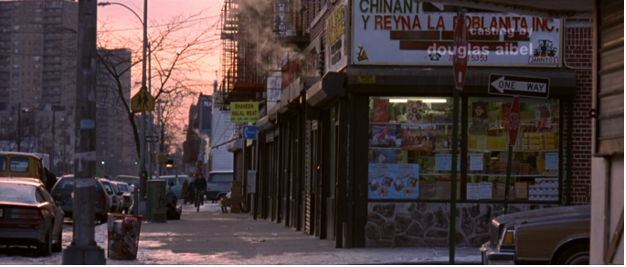

Whether the film’s main character is
Edward Furlong or Tim Roth can be debated (it’s at least worth noting Gray’s
claim that he and editor Dorian Harris, after a disastrous and ego-destroying
first cut of the film, found things coming to life after recutting/refocusing
the film around Roth’s character)—but perhaps they both are. This gives us two
films intertwining each other, one a dark tone poem wrapped around Roth’s
simmering silence, the other a tender portrait of youth. Gray claims to have
taken the kid-rides-around-on-his-bike idea from Jerzy Skolimowski’s Deep
End (1970)[7],
another film of youth finding its way in an adult world that avoids clichés,
although in a very different tonal register. If the stylized veneer of Little
Odessa is ignored, the film has more than a little documentary impulse,
embodied in the opening minutes as the title credits roll, which includes a
shot of Furlong getting onto the subway that Gray “stole” in real life. If
nothing else, the film certainly captures the ambience of a certain kind of
teenage life, biking, sitting, listening, being—a portrait of Edward Furlong’s
captivating face, our emotional center given the inaccessibility of Roth’s
machine-like stoicism. On the film’s DVD commentary track Roth attests that
Gray told his actors not to act, an attempt to remove all mannerism, all
layers between actor and character. This is evident—“lived-in” doesn’t even
begin to describe the performances Gray elicits, especially from Furlong (who
would, it seems, never again be given an opportunity to give of himself in a
film as much as he gave here); more than most films, the Rivettian dictum that
films are simply documentaries of their actors rings true here.
That attention to ambience is true
elsewhere, not least obviously on the film’s soundtrack; Gray nods to
Polanski’s work on Rosemary’s Baby (1968) as an inspiration for having
the film’s sound be appreciatively ambient; the film certainly strikes an
interesting dichotomy between heavy Russian choral music[8] (which Gray shilled out a
decent portion of the budget to ensure he had) and the ambient sounds that
exist around its appearances. Here and in Gray’s subsequent work also is the
use of “singing semis,” a sound effect originally created by Walter Murch on
Coppola’s The Rain People (1969), an important precursor to Little
Odessa in the use of sound and ambience; it's an effect that gives a
three-dimensional element to the world of the sound—in Little Odessa, contributing
to the sense that there’s a whole world out there going on indifferently to the
intense family drama playing out.
__
Here, a painting influence is explicit
rather than an amorphous inspiration or spiritual aesthetic guide: this shot of
Schell, monologuing in bed next to his mistress (Natalya Andreychenko, Schell’s
real life wife and herself one of Russia’s leading film actresses), is based on
some self-portraits done by painter Max Beckmann.


__
Perhaps the most prevalent criticism
I’ve seen of Gray’s cinema is that it’s derivative, copy-and-pasted, without
original ideas. That will be addressed explicitly and implicitly throughout
this series more than once, but it’s important to note that as with any
filmmaker, Gray’s explicit intentions are liberally mixed with the subconscious
intuitions and preferences built up over his whole life. For me, however, any
structural or aesthetic intentions are lost when watching the film, in the
sense that they don’t register so overtly as to be forced or ill-fitting. The
intent is that these things work subconsciously on the viewer. For example: one
doesn’t consciously notice (or at least I didn’t, until I listened to Gray on
the DVD commentary) that the last quarter of the film becomes.... something
else, formally. Camerawork is almost exclusively kept to either handheld or to
zooms, either way always on the move; dialogue disappears or is kept at a
minimum; and the momentum of the film takes on an increasingly poetic bent, as
if the story had been unlocked from its narrative shackles in order to rise to
the level of something more mythic. One needn’t think of this subtle formal shift
as something specifically philosophical—for example, that a deterministic or
fatalistic view of things was being offered—because the story and the images
telling it engross one to such a point that philosophical reflection takes a
backseat to emotional attention. In Gray, the idea never proceeds the emotion;
it is enveloped in it, hidden in it. It’s not that there aren’t ideas, but that
they are felt before they are thought (if one even wishes to make that
distinction—perhaps we have a false idea of our rational powers and ideas are
more heart-things and less head-things than we think). It almost feels like a
betrayal of the film to translate its emotional ideas into words on paper. For
if one were to do that, there might even be a slight disappointment in how
banal, how unoriginal they feel.
When we look back a hundred years from
now Gray’s lasting contributions may seem slight, if we’re looking from a
perspective wishing only to see what followed what on the timeline of original
ideas. But if we’re looking from a perspective that sees the depth and clarity
in which essential ideas—never young, never old—are communicated, then Gray’s
films will jump out. There’s nothing new under the sun, but the force with
which those not-new things are expressed—their clarity, their directness, their
earnestness—can very much be new and refreshing. The old can be made new—or, at
the very least, made to be realized as lost. These aren’t necessarily ideas
that can be stated in easy phrases. Some of them are intangible,
untranslatable: the feeling of a room, the pace of a caress, the distance
between two bodies in one frame—for these are ideas as much as more
philosophical ones. For a film in which every moment is offered as the holder
of veritable human presence, thought, and emotion, to say that some overarching
idea—to offer just one example, that class is but another name for fate—is more
integral, or more profound, or more important than the here-and-now on-screen
embrace between, for example, mother and son, is to miss the unmeasurable and
irreducible nature of not just this film but all of cinema. Every moment has
equally infinite importance; we simply read some as more significant than
others for the ease of explaining to ourselves and others what the film is or “means”
or “says.” This is unavoidable as imperfect humans, but it’s films like Little
Odessa that remind us of this core truth, that the irreducible experience
of a film is just that: irreducible.
__
Gray saw the first cut of his debut
film in March 1994—according to him, a day his ego has never recovered from. But
it all came together well enough to nab a debut at the Venice Film Festival,
from which it emerged as a winner of the Silver Lion (which was also awarded to
Peter Jackson’s Heavenly Creatures and Carlo Mazzacurati’s Il toro that
year) under a jury headed by David Lynch (other notable presences both on the
jury—Olivier Assayas and Nagisa Ôshima—and off: Claude Chabrol, who loved the
film). Redgrave also won Best Actress. At the time, however, Gray had already
departed from Venice[9] depressed and disappointed
at the seemingly undistinguished reception of his film; but he quickly hopped
back on a plane upon hearing the news, and was soon accepting the award on
stage from a recently retired Monica Vitti. The European success of the film
continued with a shared top prize at the Deauville Film Festival in France.
The film’s American premier, before
opening in theatres in May of 1995, came via the Sundance Film Festival that
January, which was made retroactively significant by two facts known to me.
One, Brad Pitt saw Little Odessa at the festival and later called Gray
to express his admiration, leading to a long and fruitful friendship not only with
Pitt but also with his girlfriend at the time, Gwyneth Paltrow. Two, a very
interesting cultural document was made—Michael Almereyda and Amy Hobby’s
interview film/documentary At Sundance (1995), in which a young Gray can be seen
spouting his patented philosophy of artistic longevity in response to questions
about the future of movies, on January 26, 1995. Which can be watched here, or read here:
You know, people can deny this as much as they want, but the only
thing that you really try and do with movies is in some small way—however sort
of inadequate—is kind of carve out a little place, a tiny, insignificant maybe,
place, of immortality. And by that I don’t mean some sort of egomaniacal thing
(although sometimes it does take on those proportions), but that somehow you
can make a work that has some sort of lasting impact and power, and that people
will watch it 50, 100, 200 years from now just as surely as we will look at
Guernica generations from now and realize its true greatness. I mean, people
100 years from now, I think—I think—will be able to watch... The Godfather: Part II, and see it
as a sort of monumental achievement. And I think that as filmmakers that’s what
you hope to do. And in a way, it sounds sort of megalomaniacal, but that’s what
I hope to do, in some small way, is to try and achieve something where it
matters to people on an emotional level, that it has some sort of resonance with
people for years to come. That’s really the only thing that matters to me. And
if you’re lucky, it means you can do it for two moments, maybe, in a movie, and
even if you’ve made 20 movies if you’re lucky enough to do that, cause it’s the
hardest thing in the world to do, to make a movie. Orson Welles has that quote
about, you know, To make a movie, any movie, good or bad, is a sort of great
achievement, and to make a great movie is nothing less than a miracle. So, he
got granted several miracles in his life I guess, but there is an element of
truth to that, that if you can do that, if all the elements come together,
that’s all that I hope to do. And if I can do—if I can have a moment of that in
anything I ever make I’ll be blessed forever. Sounds really corny, but that’s
the way I feel.
.png)
__
One is certain of nothing but the
truth of one’s own emotions. – Howards End (1910), E.M. Forster
James Gray was asked at the film’s
Venice press conference if “there is hope in the world.” He answered “no”—(“I
think jokingly,” says the reporter). It’s no doubt Gray’s gloomiest film, with
the darkest philosophy of the world and human nature as we’ll ever get from
Gray. But if this changes it will usually be a matter of shading than a
complete shift in color. Whether the film, or Gray himself, subscribes to some
kind of fatalism or determinism is largely beside the point; because really all
one is left with, watching Tim Roth sitting in his car, tragedy unfolded all
around him, is an infinitely complex feeling, a knot in the stomach, an
impossibly specific emotion with no one name. In some ways, the film—and Gray’s
work overall—is an intensely moving gesture toward the impossibility of
categorizing human emotions. Their eternal specificity is played out again and
again, and in their representation is not just some kind of scientific
cataloguing of their existence, but a courageous and loving statement that,
Yes, this emotion exists, and the person who is feeling it matters. And by
extension: the viewer matters, and all of the emotions one feels are valid
simply by virtue of you, a human being, feeling them. To put it in terms
veering dangerously close, or perhaps to the very point of, cliché: it is
nothing less than the validation—and therefore the embrace—of the human
condition.
For a film as vulnerable as Little
Odessa, even a little bit of vulnerability on the part of the viewer should
be enough to feel some of this connection, some of this idea—that emotions
matter. And this vulnerability is what the film, what James Gray, asks of the
viewer. The opening minute of darkness, the gently rising music, the slow
reveal of Tim Roth’s shadow-shrouded face, has absolutely nothing to do with
the plot of the film—it exists almost as a gentle but insistent rhetorical
question: You, viewer, are you ready to watch, to listen, to be vulnerable for
a time? Settle in. It’s the formation of a womb-like relation between film and
viewer; and if this philosophy of viewing makes itself manifest in a
preference, for Gray, for theatrical exhibition, it’s because that’s the
closest external parallel to what the film-viewer relation looks like in
non-material reality. But the conditions ultimately don’t matter—given the
right emotional circumstances, that theoretical womb can be formed in the
unlikeliest of places to an even greater extent than might be possible in a
theatre.
It's hopefully beginning to be made clearer
that there is a deep philosophical root, an almost primal, pre-thought
emotionality, to the external form (film grain) of Gray’s cinema and his
related opinions (theatrical exhibition). The surface images of Little
Odessa attain a simplicity and elegance not because they simply “look good”
or work well with the story (although both are true), but because something
deep inside Gray, something intimately connected to his way of thinking and
feeling, prizes above all a clarity of emotional expression connected to a
validation of the most intimate and internal elements of the human experience;
which can, for Gray, most clearly be gotten at by the removal of all formal
distraction and narrative bumps. Thus, the creation of a smooth narrative
machine carried along by clean and expressive formal maneuvers for the purpose
of centering complete viewer focus on the story at hand and, by default, the
emotions that arise from it. If Gray’s aesthetic decisions lean towards the
simple rather than the complex, it’s for these deeply entrenched personal
reasons rather than some kind of arbitrary selection or a principled adherence to some kind of “classical” ideal.
And it’s obviously an intensely personal film, one that comes to
us with only a veneer of distance. One feels the need of this 23 year old
filmmaker to express himself at all costs, and at the deepest level possible,
even to the point of embarrassment. If there is the feeling of an overbearing
solemnity, it is perhaps simply the extreme earnestness of the person trying to
express himself in the most desperate of ways. For a work of art to come out of
a depression born of death and sadness and separation (the very things Gray
experienced in the years leading up to the making of this film), and coming
back home to reckon with these things via art, there is no time and no chance
to do anything less than put one’s entire weight into the expression of what
one feels. For during and at the end of the film, one is not struck by concepts
or ideas—one feels something. Above all it is a film of moods and
atmospheres, as all of Gray’s films will be, and if here those moods and
atmospheres are claustrophobic, suffocating, and overbearing, one senses that
we are not, in any case, being lied to by James Gray.[10] Here is the first chance
we have to encounter a filmmaker who puts his body and soul and everything else
into every fiber of his films’ beings; one is confronted with the heart of
James Gray splayed out before you, messy, complicated, and yet shaped into a
structure and a figure, in the guise of a narrative, in which he has attempted
to show you part of himself—nay, all of himself. The filmmaking, although
already remarkably coherent and mature, will get better. Gray will learn his
craft more and more with each subsequent film, and he has no issue criticizing
many of his choices on this film years later. But one also feels that the
choices he made were the choices he, in a way, had to make. If the fate
of the film’s characters is solemnly and slowly decided more and more as the
film progresses, then one feels that Gray too, from his very childhood, was
marked out in the cosmos to make this film. For as we will realize with each
subsequent effort of Gray’s, the making of the film occurs not just in the days
before, during, and after production of the film has commenced—rather, it is a
life-long undertaking, in which one is shaped and molded into the person that
one is at the time of conceiving and making the film. In other words, the film
is the man. (Orson Welles: “I believe a film is good to the degree that it
expresses the man who made it.”) The films of James Gray are the most intimate
translation of one man’s emotions, from soul to screen, as he can possibly make
them. Little Odessa is James Gray, or at least it’s the James
Gray of age 23, 24. He will of course grow and mature, as a man and as a
filmmaker—the rest of this book exists to show that he does, and how. But when
the viewer is vulnerable, and one lets the film wash over oneself as the
artistic expression of one human being to another, there is created a
connection from person to person that, I would argue, single-handedly proves the
intangible benefit of art—“if I may use that dirty word,” to borrow a turn of
phrase from Gray himself.


__


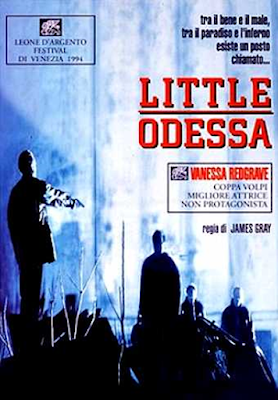


(A passing mention in Nanni Moretti’s 7-minute short film Il
giorno della prima di Close Up [Opening Day of Close-Up, 1996].)



[1] It’s likely that Gray saw Kelly in Twin Peaks: Fire Walk with Me (1992), playing Donna in replacement of Lara Flynn Boyle from the television series, a film which Gray was ahead of his time in admiring. Kelly is also a Queens native, but of Irish heritage. Three months before Little Odessa one could hear her voice as Nala in The Lion King (1994). (I find something beautiful about this: that the voice of this small character in this film that means so much to me has been preserved for all time in what is probably one of the most-watched movies by people of my general generation....)
[2] Schell, perhaps most famous for his role as a German lawyer defending a Nazi judge in Stanley Kramer’s Judgement at Nuremberg (1961), here instead plays the Russian-Jewish patriarch. Little Odessa’s Holocaust parallels are unintentional but arguably present (the makeshift incinerator used to dispose of bodies), at least present enough to warrant a mention of Schell’s connection with Kramer’s film. A film in which none other than Burt Lancaster plays his client, who appears in Little Odessa via an excerpt from Vengeance Valley and elsewhere finds significance in the Gray universe for his role in Luchino Visconti’s The Leopard (1963). To extend the connections even further (therefore making it even more fun for me), Schell’s sister Maria worked with Visconti too, as the female lead in White Nights (1957), which has obvious connections with Gray’s later Two Lovers (2008).
[3] Redgrave’s casting was completely serendipitous. Around the same time as Little Odessa was set to shoot she was going to be in New York City for a week doing something for the United Nations for the war in Bosnia, and had four extra days; her agent contacted Gray’s producer asking if he had anything for her, and Gray’s film became the lucky beneficiary.
[4] And he suffers a
similar fate as that of Delon in Alain Cavalier’s The Unvanquished
(1964), the image of which was used as the cover of The Smiths’ The Queen Is
Dead (1986).
[5] The change
simply due to when funding came available. Another major change: Gray had
originally conceived it as “almost a guerilla-type movie” (the remnant of this
idea perhaps visible in the handheld kidnapping sequence), but he decided to go
another, more formally elegant, route once he got enough money to do so.
[6] Word has it that
Kent Jones once described Little Odessa as “the result of someone being
locked in a room with King of Marvin Gardens on repeat.”
[7] “I remember a very influential film at the time for me was a
movie I saw by accident. I had gone to see a double feature; I wanted to see
Jerzy Skolimowski’s Moonlighting... and instead I got the wrong time, so
I went to see his movie Deep End, which I think is a fantastic movie...
And it’s, you know, a kid riding through the streets on a bicycle, and I was
very influenced by that and also by 400 Blows and trying to make something very
personal, as autobiographical as possible....”
[8] Although giving the film a religious atmosphere, that the Russian
choral music is of secular origin feels pertinent. For it expresses, as
much choral music does, something of the divine, whether or not it is intended.
And for a story which takes place in not the absence of religion, but its
negation (none of the characters appear to be practicing Jews besides Moira
Kelly, first confronted by Joshua outside a temple), it gives rise to a
profound feeling of sadness and alienation—the feeling of a great clash between
this spiritual something and the film’s ostensibly gritty, material world.
[9]
In which he had stayed at the same hotel as appears in his beloved Visconti’s Death
in Venice.
[10] Reinhold Zwick (translated with the much-appreciated assistance of Florian Weigl) points out, however, that labeling the film unendingly dark and pessimistic misses something essential about it:
Little Odessa's final sequence with its last look at Joshua again emphasizes what I perceive to be the Christian attitude towards evil that permeates the entire film. What the Apostle Paul knew, Little Odessa vividly gives shape to: in both it is about the knowledge of the abysmal tendency of man towards sin as part of the human condition. What Paul said in a famous phrase from Romans, in unsparing self-exposure of his own inner being, could also apply to Joshua Shapiro: “I know that nothing good dwells in me, that is, in my flesh; the willing is there in me, but I am not able to do the good. For I do not do the good I want to do, but the evil that I do not want to do. But if I do what I don’t want to do, then it’s no longer me doing it, it’s the sin that dwells in me.” What Paul’s anthropology conceptualizes through the medium of the word is also spoken through the images and story of Little Odessa: that man is not completely condemned to this tendency to sin. By investing in the possibility of recognition and change, Gray’s film retains through its darkness a quiet optimism—quiet because based in realism! That is why Gray refuses to allow everything to sink into gloom and fatalism, as some critics have wrongly suggested, but rather charges his images and his narrative with the possibility of change and the hope for grace.


